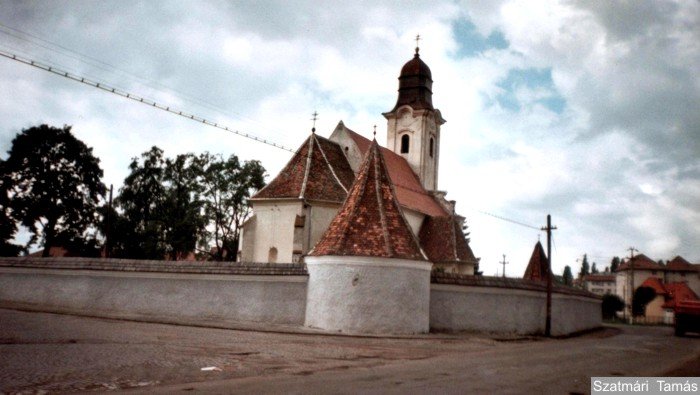
Armenian Catholic Church
The "Church of the Nativity of the Blessed Virgin Mary" — the baroque pride of Gheorgheni,
built by a refugee Armenian community that arrived from Moldavia in 1668.
The Church of the Nativity of the Virgin — a baroque jewel
The Armenian Catholic Church in Gheorgheni (also known as the Church of the Nativity of the Blessed Virgin Mary) stands in the north-eastern part of the town, along the road leading to Lacul Roșu. This baroque building is one of the most important sacred and cultural centres of the Transylvanian Armenian community — a fortified-church-style monument enclosed by a stone wall and two squat towers.
"Two kinds of people live in this region: those who know they have Armenian ancestors, and those who don't yet know. Because Armenians were and are everywhere."
A migration of thousands of kilometres
Armenians have never had an easy life — after the Seljuk Turkish conquests, around the turn of the first millennium, many left Armenia. After several hundred years in Crimea and Moldavia, they reached Transylvania in search of a "refuge".
Gothic chapel
On the site of today's church there already stood a Gothic chapel built around 1450, used in the early years by the newly settled Armenians.
First Armenian settlers
Arrival in Gheorgheni of the first documented Armenian brothers — Hörtz Azbej and Vartik. Passing through the town, they were often seen at the local market.
Mass settlement
Several hundred Armenian families arrive in Gheorgheni from Moldavia. Gheorgheni had earlier received town status in 1607 — the Armenians seized that opportunity.
Right of settlement
Mihály Apafi I, Prince of Transylvania, granted the Armenians the right of settlement — which formally established their legal status in Transylvania.
Church plot
They buy the plot called the "cemetery of foreigners", with a small chapel. A curious clause: if they leave the town, they cannot claim back the price — showing that they still regarded Gheorgheni as a temporary stay at the time.
Construction of the baroque church
On the site of the Gothic chapel, today's baroque church is built in 4 years. Construction advances in parallel with the town's rise and with the economic power of the Armenians.
Consecration
The church was consecrated in honour of the Nativity of the Blessed Virgin Mary — hence its Hungarian name "Kisboldogasszony" (Church of the Nativity).
The 4 Armenian settlement centres
Four major Armenian settlements emerged in Transylvania — of these, Armenian life in Gheorgheni remains the most active to this day, though no longer what it once was.
Gheorgheni
Gheorgheni (Armenian: Dzsurzsov)
The most active Armenian community in Transylvania today. Here you find the baroque church, the Armenian Community House, and the tradition of hurut soup originated here.
Gherla (Szamosújvár)
Armenopolis · Hajakhagah · Gherla
The largest Armenian town in Transylvania. A 19th-century centre of modern banking and commerce.
Dumbrăveni (Elisabethstadt)
Jeghiszapetupolisz
The Armenian centre on the Lesser Târnava valley. A once-thriving commercial and religious community.
Frumoasa
Csurcsov · Szipviz
The former centre of the Armenian community of Ciuc, with an Armenian Memorial House still active today.
What to see?
Curtain wall and bastions
The church is enclosed by a loopholed stone wall with two squat towers, giving it the character of a fortified church. The walls recall the Armenians' need for self-defence.
Venetian altarpiece
The exceptionally valuable altarpiece of Saint Gregory the Illuminator was painted in Venice in 1752. Beside it stands a richly ornamented baroque pulpit.
Stations of the Cross
In the inner niches of the curtain wall, you can see reliefs and paintings dating from around 1750 — one of the church's most intimate artistic experiences.
Church tower and panorama
The baroque tower dominates the surrounding skyline. From the top, you can survey the entire Gheorgheni Basin, the surrounding mountains and the town's red-roofed houses. Several bells hang inside.
The great bell
Among the bells in the tower, the great bell was cast in the mid-19th century. Its sound is the signature voice of the town.
Armenian Arts Festival
Once a year the town hosts an Armenian gastronomic festival — on that occasion, the church tower is also open to the general public.
Seven-hundred-year-old manuscripts and rare books
The parish library is a true gold mine, whose contents researchers catalogued only recently. Three outstanding items:
Surkhat Gospel (1354)
The cover of this manuscript, made in 1354, is the library's most precious item. Surkhat (today Staryi Krim) was once a flourishing Armenian centre in the Crimean Peninsula. The manuscript is nearly 700 years old — you may simply walk into the parish to see it!
1666 Astvatsashunch
The first printed Holy Scripture in the Armenian language — issued in Amsterdam in 1666. A copy is kept here. Its original name — "Astvatsashunch" — does not mean "Holy Scripture" but "Breath of God". The date in Armenian letters: 1115 (the Armenian calendar is offset by 551 years).
1824 Directorium
A publication regulating the liturgical rites. A special detail: it bears the names of the 4 Transylvanian Armenian towns: Jeghiszapetupolisz, Gerla, Dzsurzsov and Szipviz.
The "Armenian dawn", hurut and the red-cloaked guardians
The "Armenian dawn"
The Armenians were traders. At dawn they would buy up the entire market from local producers, so by the time the "ordinary" townspeople arrived, they found only the Armenians — who resold the goods at 2 to 3 times the price. Hence the saying.
Hurut soup
The most famous Armenian gastronomic heritage in Transylvania. Hurut: curdled milk is stirred daily for several weeks, then mixed with parsley leaves, boiled and drained. The soup is called aganjabur — "ear soup", because the pasta garnish resembles little ears.
The Red-Cloaks
Once members of the young men's confraternity, today they are parish councillors. According to tradition, during the migrations they guarded the priest and the Blessed Sacrament — a kind of soldiery. A curiosity: this role survives only in Gheorgheni, nowhere else in the Armenian world.
Merchants and bank founders
The Armenians contributed greatly to the bourgeois development of Gheorgheni. They founded the town's first savings bank and later the bank itself, and later did so in the surrounding villages too (e.g. Joseni).
The secret of Armenian surnames
In the town people say: by the name alone you can tell who is Armenian and who is not — and it really does work with surprising accuracy. Three categories:
From the Mercantiel Forum to the closing of the school
The Armenians here enjoyed self-government — they had their own decision-making body, the Mercantiel Forum, which was conducted in Armenian.
The last Armenian-language year
In this year the Mercantiel Forum was still conducted in Armenian. From the start of 1800 onward, they switched to Hungarian and to the Latin alphabet — this is when we date the abandonment of the language.
Closure of the Armenian school
The last institutional step — with the closure of the Armenian school, the language fell definitively out of use. Today it lives on in the liturgy in its Classical Armenian form.
Famous people of Armenian descent
The Armenians are an inventive nation. They invented the first ATM and the magnetic resonance imaging used in diagnostics.
Known around the world
Hungarian and Romanian Armenians
Useful information
How to find
- Address: 1 Armenian Church Street
- Phone: +40 266 361 517
- Parish office: 4 Petőfi Sándor Square
- GPS: 46.7247° N, 25.6059° E
Opening hours
- Open during services
- The exterior can be viewed at any time
- Sundays: Armenian-rite Mass
- Tower: during the festival or by appointment
What to see
- Venetian altarpiece (1752)
- Baroque pulpit
- Stations of the Cross along the curtain wall
- Tower panorama over the basin
- Surkhat Gospel (1354)
Tip
- Armenian Community House at the parish
- Annual gastronomic festival
- Learn an Armenian word: "hadzso" = hello
- "Shorhagalutjun" = thank you