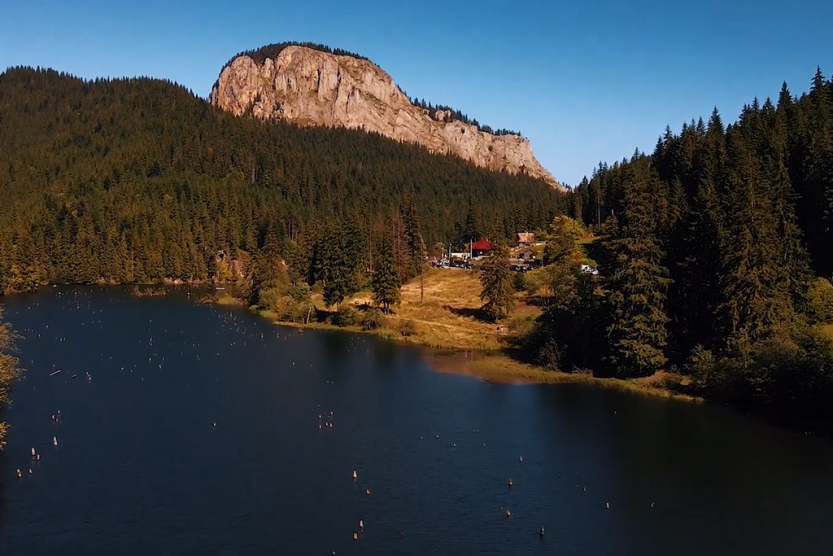
Lake Roșu (Red Lake)
Born of a summer storm in 1837 — where a mountainside collapsed and the waters of five streams sealed in a sunken spruce forest.
Romania's largest natural dammed lake, in the heart of the Hășmaș Mountains.
Source: visitharghita.com
Transylvania's "youngest" lake — barely 188 years old
Lake Roșu (Hungarian Gyilkos-tó, "Killer Lake"; Romanian Lacul Roșu, "Red Lake") is one of the most striking natural wonders of the Eastern Carpathians. A natural dammed lake in the Hășmaș Mountains, in the north-east of Harghita County — of substantial size, yet relatively young: it formed in the summer of 1837.
To the north, the lake is dominated by the 1,344-metre rock face of Suhardul Mic (Little Cohard), surrounded by the marble-white limestone peaks of the Hășmaș Mountains: Suhardul Mare, Vârful Licaș and the Killer Mountain (Ghilcoș) itself. To this day, the broken trunks of the drowned spruce forest still rise from the lake — a haunting sight that gives the lake its unique character.
Administratively, the area belongs to the town of Gheorgheni — including the popular Lacu Roșu resort on the shore. The lake itself lies within the Cheile Bicazului–Hășmaș (Bicaz Gorges–Hășmaș) National Park.
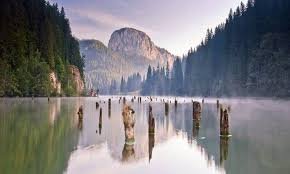 Lake Roșu and the towering rock of Suhardul Mic · visitharghita.com
A storm that gave birth to a lake
In the summer of 1837, the clay-laden debris that had accumulated on the slope of Mount Ghilcoș (1,378 m) crashed down into the valley after heavy rains. It struck the south-eastern foot of Suhard and blocked the course of five streams in a single blow.
Summer of 1837
It was a rainy year; in late July vast dark clouds rolled in from the east. The downpour lasted for days — with thunder and lightning — until the mountainside could bear it no longer and gave way.
Five streams dammed
The landslide simultaneously blocked the Suhard, Licaș, Vereskő (Red Rock), Lóhavas and Sheep streams. The gathered water filled the new basin in just a few weeks.
The drowned forest
The water flooded an entire spruce forest. The bark and roots of the trees were preserved in the mud, and their trunks still rise from the water to this day — the lake's most iconic sight.
"On this occasion, the two mountains at Bicaz — soaked by the great mass of water and sliding down because of their poor soil — also collapsed in the highlands of Gheorgheni; the stream flowing through there was thus blocked, and Lake Roșu was formed from it."
Eszter and the revenge of the mountains
One of the most beautiful love stories of Transylvanian folklore is woven into the lake's origin — the tale of a beautiful girl from Gheorgheni, Fazekas Eszter.
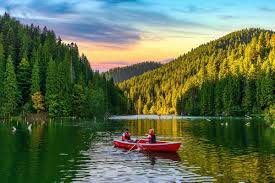 Boaters on the lake · local source
Eszter met a brave, skilful young man at the Gheorgheni fair, and they fell in love. But they could not marry — the lad was taken away as a soldier and did not return home for a long time.
In those days a dreaded brigand lived in the Gheorgheni Mountains, holding the valley in fear. The outlaw saw Eszter and tried to abduct her. The girl fled into the mountains, and when she had nowhere left to run, in her despair she called upon the mountains for help.
The mountains heard her cry. A mighty storm, thunder and an earthquake answered — the side of Mount Ghilcoș shook and crashed down into the valley. The brigand was buried beneath it… but Eszter also perished. In her memory, the people named the lake hidden in the water "Killer Lake" (Gyilkos-tó).
The shrinking wonder — could vanish by 2080
Lake Roșu is not eternal: the streams that flow into it slowly silt it up. Aerial photographs prove that it has visibly shrunk over the past decades.
Ferenc Herbrich's first survey
The lake was first surveyed by Ferenc Herbrich in 1859 — its area was 56 cadastral acres, that is, about 32 hectares.
Classical dimensions
Perimeter: 3,090 m · surface: 126,340 m² · water volume: 680,000 m³ · maximum depth: 10.5 m. Inflow from tributary streams: 1–1.5 m³/min.
Decreasing trend
Perimeter down to 2,800 m, surface 114,676 m², water volume 587,500 m³, maximum depth 9.7 m. It lost nearly 1 metre of depth in 30 years.
Total disappearance of the lake?
According to 1968 data, the lake silts up by 4.88 cm per year. Without human intervention, Lake Roșu could disappear completely by 2080. Two sediment-trap dams try to slow the process, but they are already outdated.
Before you set out
What can you see?
- The spruce trunks rising from the water
- Views of Suhardul Mic and Mount Ghilcoș
- Boating (in summer)
- Footpath around the lake (~30 min)
- Lacu Roșu resort
Best time to visit
- Open all year round
- Autumn: most colourful sight
- Summer: boating, longer hikes
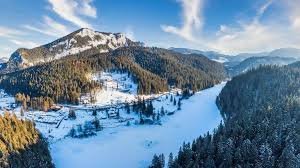
- Winter: snow-white, quiet atmosphere
- Spring: freshly green forests
How to get there
- From Gheorgheni: 29 km via national road 12C
- From Miercurea Ciuc: 91 km
- From Toplița: 71 km
- GPS: ~46.7944° N, 25.7986° E
- Parking on the shore (paid)
Hiking options
- Walk around the lake (family-friendly)
- Suhardul Mic via ferrata (for advanced)
- Bicaz Gorges (10 km away)
- Hășmașul Mare peak (1,792 m)
- Vârful Licaș panoramic route
Did you know?
The lake's Romanian name, Lacul Roșu (Red Lake), has been official since 1936. The reddish hue comes from the iron-oxide-rich clay carried by the Vereskő (Red Rock) stream, intensified by the red cliffs of Mount Suhard.
The spruce trunks rising from the water are a unique phenomenon in the Romanian waterscape. The surviving trunks are over 180 years old — their underwater roots block the entry of oxygen, preserving the wood.
Some attribute the lake's formation not to the summer storms of 1837, but to the earthquake of 11 January 1838. The debate between the two explanations is still unresolved — most likely both contributed to the collapse of the mountainside.
The lake is not entirely still water: 1–1.5 m³ of water flows in per minute, and the Bicaz stream drains the surplus — from here, the lake's water sets off through the famous Bicaz Gorges towards the Bicaz River.