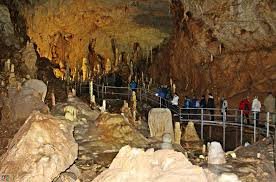
Bear Cave
A "roofless" karst formation made of deep, narrow rock fissures and corridors —
named after the Ice Age Ursus spelaeus remains discovered here.
A unique karst formation
The Bear Cave of Borsec (Romanian Peștera Urșilor, Hungarian Medve-barlang) is in fact a "roofless" karst formation consisting of deep, narrow rock fissures and corridors. It is not a conventional dripstone cave — it is something more exciting: a natural karst system studded with huge boulders and deep clefts.
🐻 The cave is named after the fossils of Ursus spelaeus, the Ice Age cave bear, found here. Right next to it lies a similar formation, the cave known as "The Porch of Hell".
🌳 The whole area is part of the Kerekszék karst zone — a 40-hectare geological and botanical nature reserve east of Borsec. The cave lies south of the Bor Stream valley, the valley that holds the largest travertine (freshwater limestone) deposit of the Borsec basin.
💎 The limestone was shaped by infiltrating water — natural erosion carved out the passages, niches and smaller caves.
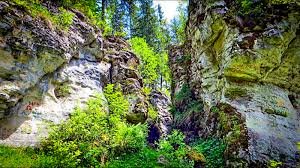 The rock fissures of the Bear Cave · local source
Ursus spelaeus — the extinct giant of Europe
🦴 The cave bear (Ursus spelaeus) is an extinct species of the bear family that appeared roughly 250,000–300,000 years ago in Pleistocene Europe and vanished at the end of the last Ice Age, the Würm glaciation — around 24,000 years ago.
📏 Size: the cave bear was one of the largest land predators. Adult males could reach 400–500 kg — one and a half times the size of the modern European brown bear.
🏠 Lifestyle: the cave bear was mostly herbivorous and hibernated in caves — exactly the kind of cave as the Bear Cave at Borsec. Many bears died during hibernation — which is how the fossil deposits built up.
🔬 European significance: cave bear remains have been found at several sites in Transylvania. The Borsec specimens make up an important locality of the Carpathian Basin Ice Age fauna — displaying these fossils is a key piece of the natural heritage of Borsec.
How do you reach the Bear Cave?
The cave is not right in the town centre, but is reached by a pleasant walk through the forest. The trail is easy and suitable for families too.
Start from the spa resort centre
The educational trail begins in the centre of Borsec. The blaze is a red triangle.
Past the Kossuth Spring
The trail runs past Kossuth Spring no. 10 — well worth a sip of its iron-rich mineral water.
On to the Petőfi Spring and the Fairy Garden
The path goes past Petőfi Spring no. 11 and the Fairy Garden Bath.
Arrival at the Bear Cave
Marked with the red triangle, it is a 4 km loop from the ski slope — at a comfortable pace the full route takes 4–5 hours, including stops and tastings.
The Bear Cave and its surroundings
Rock gates and fissures
The Bear Cave is not a closed cavity — it is reached through striking rock gates and narrow gorges. Pines and oddly shaped boulders surround it.
The Porch of Hell
A similar karst formation right next to the Bear Cave — even more thrilling, with winding corridors and niches.
Ice Cave
Another nearby sight — part of the Kerekszék karst system. In winter, spectacular icicles form inside it.
Travertine rock
The Bor Stream valley is the area with the largest freshwater limestone (travertine) deposit of the Borsec basin. A geological curiosity.
Mofettes
Across the 40-hectare protected area there are natural carbon-dioxide gas vents — mofettes, a sign of post-volcanic activity.
Natural forest
The area is ringed by coniferous forest, in an untouched wild setting. It forms part of the botanical reserve.
Adrenaline around the cave
🪜 A Via Ferrata adventure route has been built around the Bear Cave — with suspension bridges, iron ladders and a zip line.
💪 The experience is ideal for adventurous, sporty visitors — safety gear and guidance are provided.
💳 Price: about 50 RON per person for the full Via Ferrata route.
⚠️ Warning: The Via Ferrata is not entirely free (only the open-air part of the cave is) and requires separate equipment and a certain level of fitness. It is best to check with the tourist office in advance.
The Bear Cave on the map
The map below shows the exact location of the Bear Cave — east of Borsec, in the Kerekszék karst zone. Click the marker for details.
Source: Excel database A38 — GPS: 46.9662°, 25.56714° | Map: OpenStreetMap
Useful information
How to find
- Place: east of Borsec
- GPS: 46.9662° N, 25.5671° E
- Blaze: red triangle
- 4 km loop from the ski slope
When
- Open to visitors all year round
- Entry: FREE
- Best months: May – October
- Take care in cold winter conditions!
What to bring
- Hiking boots (mandatory)
- Torch / headlamp
- Water, a small snack
- A camera if you like
Tips
- Combine with the Fairy Garden
- Via Ferrata: 50 RON per person, separate
- Plan a 4–5 hour outing
- Take care in the deeper fissures!