The birth of a spa town in the embrace of the Carpathians
From the shepherd boy's legend through imperial patronage to the modern spa — almost two centuries of history at the foot of the Ciomatu (Csomád) Mountains
The basis for the touristic and balneological development of Băile Tușnad (Băile Tușnad) is the post-volcanic activity of the Ciomatu (Csomád) Mountains — the youngest volcanic formation in the Carpathians. The gases emerging at the surface, rich in carbon dioxide and hydrogen sulphide, together with the mineral waters, created the conditions for therapeutic treatments thanks to which the settlement could rise to the status of a renowned spa. This natural treasure was used for bathing by the local Székely population from very early times.
Early history and strategic role
Iron Age fortress and medieval watchtowers
Although Băile Tușnad came into being as a modern spa town in the 19th century, thanks to the area's geological and geographical features, the region was inhabited from time immemorial. On the Castle Hill, towering above the Olt Gorge, the ramparts of one of the largest Iron Age fortresses in Transylvania — covering about 2 hectares — are still visible today.
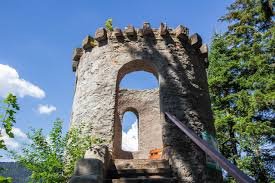
In the Middle Ages, the region served as a vantage point against possible enemy incursions. This is attested by the ruins of Sólyomkő Castle, still defying time on the rocks of Lower Sólyomkő, as well as the remains of the former watchtower on Upper Sólyomkő, which testify to the early strategic importance of the area.
The beginnings of spa life
The legend of the shepherd boy (1842)
"The official history of the spa began in 1842, after a legend drew wider attention to the wondrous healing power of the mineral waters long used by the local Székelys. According to the story, a shepherd boy, while searching for his lost cattle, repeatedly waded through the marshy, mineral-rich mud of the Tisztás stream (the Beszédmező), and as a result, the apparently incurable rashes on his legs disappeared miraculously."
Founding of the joint-stock company
The news spread quickly, and in 1845, Élthes Lajos, a landowner from Tușnad, founded a joint-stock company together with six associates. The land was leased for 99 years from the villages concerned (Tușnad, Verebes, Cozmeni, Lăzărești), and the construction of the spa began.
The initiative was also taken up by Kovács Miklós, Bishop of Transylvania, a native of Tușnad, who had the so-called Bishop's House built at his own expense for poor patients — thereby laying the foundation for the spa's social mission.
Destruction and rebirth
The storms of the 1848–49 Revolution
During the 1848–49 Revolution and War of Independence, the flourishing settlement was almost entirely destroyed. The destruction was intensified by the local Székelys themselves, who, in their anger — because the joint-stock company had deprived them of their former free bathing rights — set fire to the spa buildings.
In the same period, on 5 July 1849, on the Alvégszurdoka-Tepej cliff next to the spa, the Székelys fought their last desperate battle under the leadership of Gál Sándor against the invading Russian forces.
The visit of Franz Joseph and imperial patronage
The fate of the spa, lying in ruins, was turned around by the visit of Emperor Franz Joseph in 1852. The sovereign was so enchanted by the fir-clad landscape that he personally ordered its reconstruction.
As a result, elegant, Swiss-style villas with carved wooden ornaments were built beneath the Alvégi cliff, due to which the locals have called the quarter "Switzerland" ever since. With this, the town's second golden age began.
The "Mikes era" and scientific balneology
The true golden age of the settlement began in the 1860s, under the presidency of Count Mikes Benedek. This era brought not only infrastructural development but was also the period in which Băile Tușnad rose to the rank of a scientifically grounded spa.
1868 — Scientific analysis
Mikes Benedek, at his own expense, sent the waters of eight springs to Zürich for scientific examination by the chemist Dietrich H. Gusztáv.
Start of bottling
The way was opened for the bottling and medical use of the mineral waters (Mikes Spring, Főkút).
1895 — First mofette
Imets Fülöp Jákó discovered the first mofette of the settlement (a carbon-dioxide vent).
1890 — Stefánia Sanatorium
The medical institute, applying the most modern procedures of the time, was inaugurated and remained the centre of spa life until 1975.
1896–1897 — Railway
The railway was built, connecting the spa to the bloodstream of the Austro-Hungarian Monarchy.
1900 — Csukás (Ciucaș) Lake
By draining a backwater of the Olt, the Csukás Lake was created, which in 1928 was also developed into a public bath.
The Mikes era provided the scientific and infrastructural foundation on which Băile Tușnad still builds today — from the bottling of mineral waters through the rail connection to the opening of the Stefánia Sanatorium.
The storms of the 20th century and the rise to town status
World War I
The First World War halted the development of the settlement, and the flourishing spa life was suspended for a long time.
Interwar flourishing
Between the two world wars, Băile Tușnad once again became a popular climatic spa, including among the Romanian elite.
Becoming an independent settlement
Băile Tușnad was separated from Greater Tușnad (according to some sources in 1935), thus becoming an independent settlement — an administrative milestone.
Nationalisation
During the nationalisation following the Second World War, the villas passed into state ownership.
Declared a town
During the administrative reorganisation, Băile Tușnad was elevated to town status. With this, it officially became one of the smallest towns in Romania — but its touristic significance remained immense.
The age of mass tourism
Within state investments, the Csukás, Tusnad and Olt hotels were built, which turned the town into one of the most important Transylvanian bases of trade-union mass tourism.
A new era — Tusványos
Since 1990, the Bálványoș Summer University (Tusványos) has been held, taking place in Băile Tușnad since 1997 and becoming one of the key venues of the intellectual and political discourse in the Carpathian Basin.
"Bear-Smart" community
Băile Tușnad became Romania's first bear-friendly community, combining modern technology with sustainable ecotourism — opening a new chapter in the town's history.
The historical heritage today
Every era of Băile Tușnad's history has left its mark on the town: from the Iron Age fortress through the medieval watchtowers to the 19th-century Swiss villas, from the Stefánia Sanatorium to the modern wellness centre. This more than one-and-a-half-century-old spa culture — made possible by the post-volcanic activity of the Ciomatu (Csomád) Mountains — remains to this day the town's greatest value and main attraction.
Discover the natural treasures of Băile Tușnad!
After history, get to know the natural wonders of the region: Saint Anne Lake, the Mohoș Peat Bog, the Falcon Rock (Sólyomkő) reserve and the healing mineral springs.