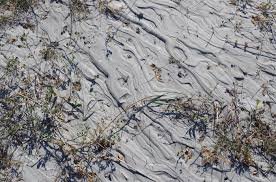
Filiași Mud Volcanoes
One of Europe's rarest natural phenomena, where methane gas rising from the depths
builds "cold" mud volcanoes — on the slope of Cserehát Hill, near Cristuru Secuiesc.
A hidden natural wonder of Székely Land
The Filiași mud volcanoes (locally known as Fehérszék) form a geological reserve of about 1 hectare southwest of Filiași, on the slope of Cserehát Hill, in the Sukoró Valley. Though less famous than those at Berca, they rank among the most remarkable natural sights of Székely Land.
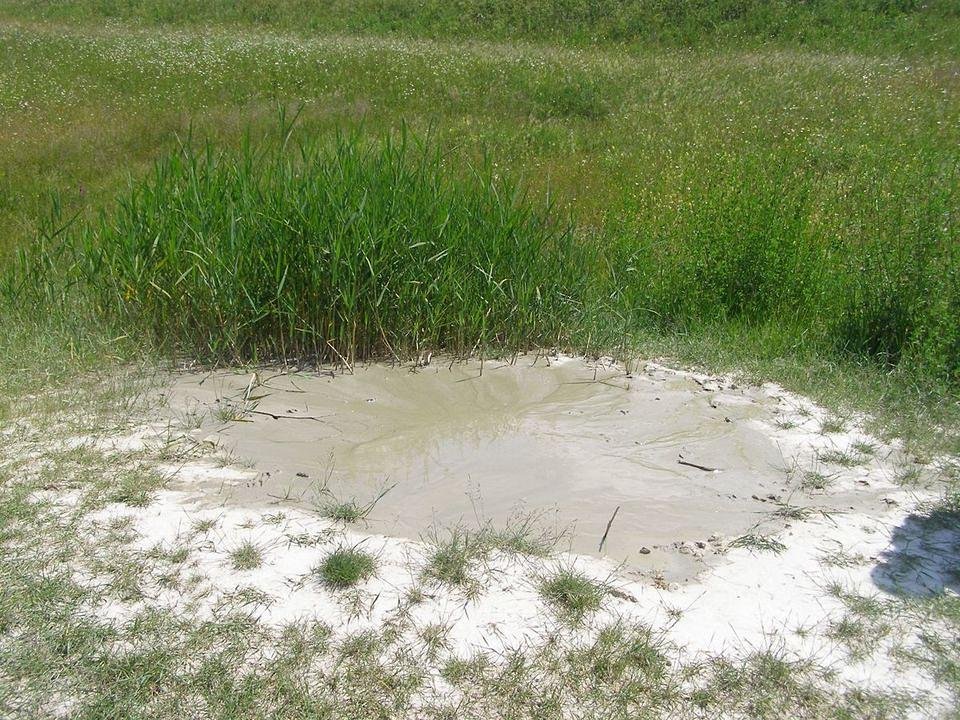
The site lies just 1 km from Cristuru Secuiesc, on the western edge of the town. Of the three mud cones, usually two are active; the third has been overgrown by vegetation and shows no signs of activity.
In the Odorhei Seat, along the White Nyikó and the Little Homorod rivers, several mud volcanoes are found — they are already mentioned by Balázs Orbán in his work "The Description of Székely Land". The scientific world, however, only discovered them in the early 1900s, following gas prospecting in the area.
 The active mud cones in the middle of the meadow · local source
The phenomenon of "cold" mud volcanoes
Despite their name and volcano-like shape, the Filiași mud volcanoes were NOT created by volcanic or post-volcanic activity! They are so-called "cold" mud volcanoes, which form in the presence of natural gas (mainly methane) — typically on loose, clayey ground.
The essence of the phenomenon: natural gas pushing up from the depths carries mud and water with it, which once at the surface gradually build cones. The process continues today — the surface is practically "growing" before our eyes.
📚 The phenomenon is rare in the Carpathian Basin and considered a rarity across Europe. Similar formations are found only at Berca, and in Transylvania in Alba, Sibiu, Mureș and Harghita counties.
The autumn 1913 "eruption"
 The three mud cones területe · helyi forrás
The Filiași mud volcanoes took on their current form in the autumn of 1913. The cause is fascinating and telling: the long summer rains caused the surface soil layer to block the gas escape route.
The pent-up, accumulated natural gas finally burst through to the surface, carrying the mud with it — so the mud cones we still see today formed in a single autumn. They have been growing continuously for over 113 years!
📚 The phenomenon was studied in detail by János Bányai, geologist of Odorheiu Secuiesc — in his work "Mud springs of Udvarhely County", published in 1932, he provided a comprehensive scientific classification of Transylvania's mud volcanoes. Bányai's work remains the foundational reference on the topic in Transylvania to this day.
Where does the name "Fehérszék" come from?
Locals call the area on the slope of Cserehát Hill, in the Sukoró Valley, "Fehérszék" (White Seat) — and the name comes from a remarkable natural phenomenon.
The mud and water that surge up have a high salt content. When the surface of the mud flows dries out in drought periods, salt crystallises out, colouring the whole area white. It feels like stepping onto a snowfield in midsummer — hence the name "Fehérszék" (White Seat).
💎 This salt is no coincidence: deep beneath the region lie major salt deposits (extending all the way from Praid), and the rising water brings them up to the surface.
Refuge of rare salt-tolerant plants
Only specialised, salt-tolerant (halophilic) plants can thrive on the salty, clayey soil. The area is therefore a unique habitat — home to plant species not found anywhere else in the region.
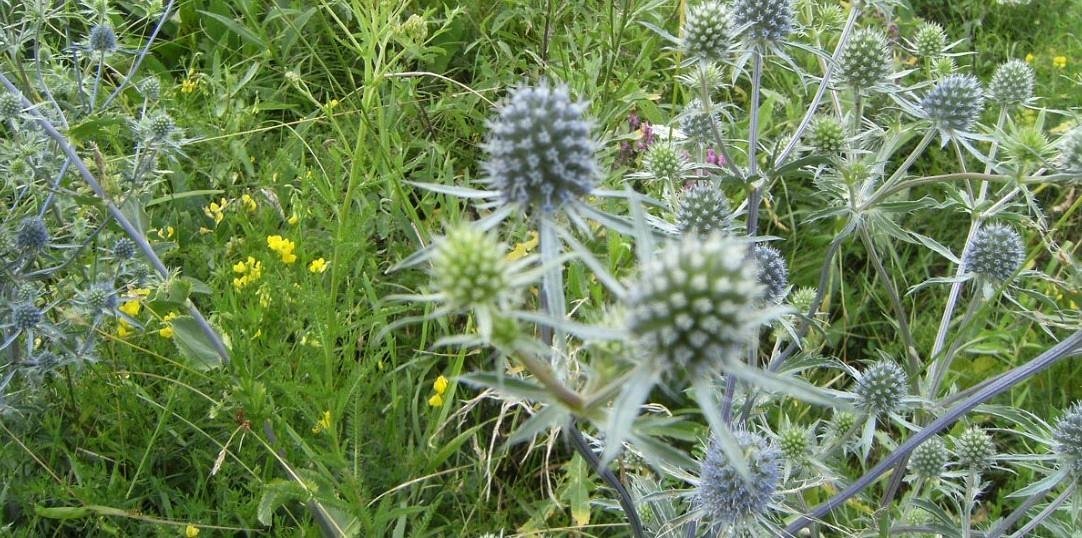
Marsh arrowgrass
Triglochin palustris — a rare and protected plant of the Filiași mud volcanoes. It grows only in very particular salt-marsh habitats.
Salt-tolerant (halophilic) grasslands
On the salty, muddy surface a distinctive halophilic vegetation has developed — grasses and dicots that tolerate the saline environment.
Vegetation-covered cone
One of the three cones is already overgrown by vegetation — nature reclaims what is no longer active. A living example of natural succession.
A research site of Babeș-Bolyai University
The Filiași mud volcanoes are not only a tourist attraction — they are also the subject of active scientific research. The Department of Physical Geography at the Faculty of Geography of Babeș-Bolyai University has been studying the phenomenon for years.
📚 János Bányai (1932) — "Mud springs of Udvarhely County" (Erdélyi Múzeum, 17/1) — produced the comprehensive classification framework of Transylvania's mud volcanoes.
📚 Andrea Gál and Melánia Lakatos (2003) — "Bubbling springs and mud volcanoes of the upper catchments of the Lesser and Greater Târnava" (Collegium Geographicum).
📚 Andrea Gál (2005) — Doctoral thesis: "Pseudovolcanic phenomena of the Târnava Plateau" (Babeș-Bolyai University).
📚 Andrea Ihos and Nóra-Emília Katona (2007) — Student research paper: "Study of mud volcano types at Filiași and Cobătești" — Faculty of Geography, Babeș-Bolyai University.
🎓 The aim of the research is to uncover the subsurface morphology and provide an international typological classification — placing Transylvania's mud volcanoes in an international scientific context.
How to find it?
The site is poorly signposted — it pays to plan the route in advance. The walk is not difficult, but orientation requires attention.
Drive through Filiași
Drive through the village all the way to the last factory building — that is where the local landmarks are.
Look for the field road on the left
About 500 metres past the village you turn off onto a field road to the left — a sign marks the junction.
Turn right at the big tree
Continuing along the field road, turn right at a big tree and cross the streambed (a small symbolic ford).
Walk up the hill
The volcanoes hide in the middle of the meadow on Cserehát Hill. Approach quietly — the landscape offers a truly special atmosphere!
Fehérszék in pictures
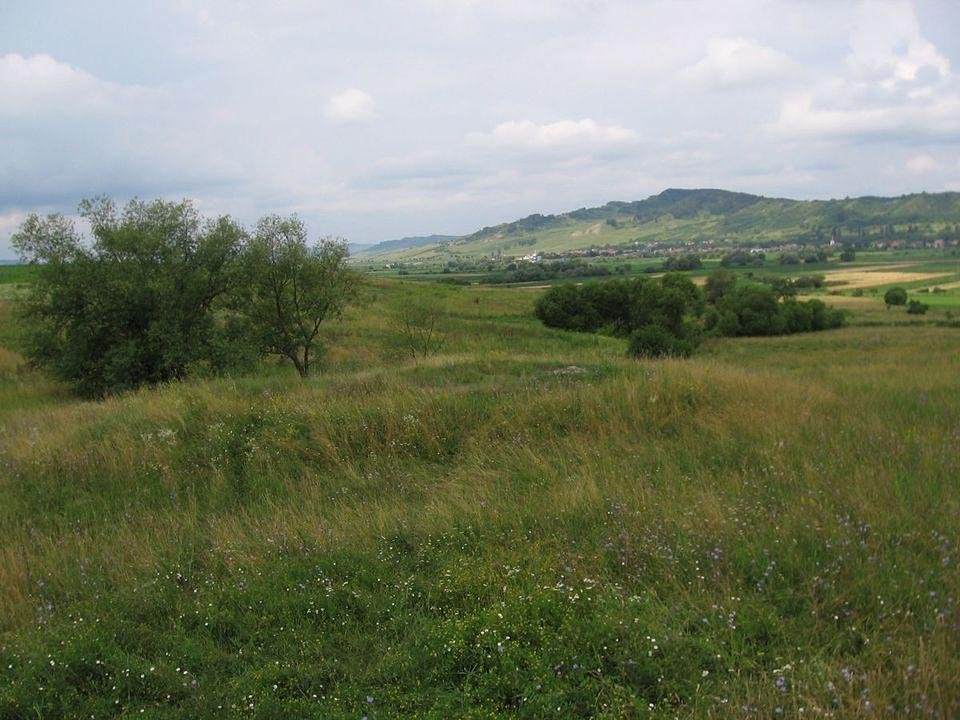
Photo sources: local sources · Excel database
Useful information
How to find
- Locality: Filiași, Harghita County
- GPS: 46.2551° N, 24.9973° E
- 1 km west of Cristuru Secuiesc
- 35 km from Odorheiu Secuiesc
When to go
- In dry weather: ideal
- In rainy weather: hard to walk (mud!)
- The white salt shows in drought
- Accessible from spring to autumn
Entry and parking
- Entry: FREE
- Unsupervised site
- Parking: edge of Filiași
- No official car park
Tips
- Comfortable hiking shoes are a must
- Do NOT step on the mud cones
- Don't pick the plants (protected!)
- Combine with Cristuru Secuiesc