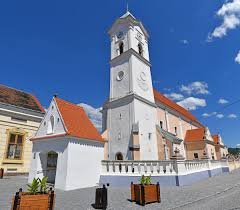
Saint Nicholas Church
The oldest monument of the town and its namesake — a Baroque parish church built with the support of Empress Maria Theresa,
whose tower still preserves the memory of the Gothic church of 1498.
The oldest monument of the town
The Saint Nicholas Roman Catholic Church of Gheorgheni is the oldest monument of the town and also the namesake of the settlement. The present Baroque building was erected in the mid-18th century with the support of Empress Maria Theresa, on the site of an earlier Gothic church.
The church is a Class "A" national heritage monument. Its present form is Baroque, but its tower also preserves Romanesque and Gothic elements — a unique combination of three architectural periods in a single building.
A special feature of the church is the Gothic door frame dated 1498 at the entrance of the tower — the direct link to its medieval predecessor, which can still be admired today.
 Side view of the Baroque church · local source
700 years at the heart of the town
Beginnings
The parish community already existed at the turn of the 13th–14th centuries, with its original centre around the fortress of Both — the present town grew up around an earlier settlement core.
The Gothic church
At this time the second church of the town was built — in the characteristic Gothic style of the period. Its stone door frame has been preserved to this day and can be seen at the entrance of the Baroque tower.
Extension under György Ferenczi
During the tenure of parish priest György Ferenczi, the church was enlarged — the needs of the growing community could no longer be accommodated in the old Gothic building.
Churchyard
The church was complemented with a walled churchyard — its surroundings were extended into a place of burial. This was a continuation of medieval ecclesiastical practice.
Baroque reconstruction
The present Baroque building was erected with the support of Empress Maria Theresa, after the old church had proved too small and been damaged in wars. After 17 years of construction, the church acquired its present form.
The main altar
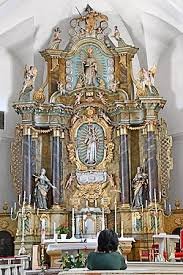
The main altar was completed 7 years after construction ended; its centrepiece is the statue of Saint Nicholas the Bishop, the church's patron saint. The altar is an outstanding piece of Baroque sacred art.
The inner treasures of the church
Main altar
Completed in 1780, its centrepiece is the statue of Saint Nicholas the Bishop, the church's patron. One of the finest examples of Baroque sacred art in Székely Land.
Baroque pulpit
A richly ornamented Baroque work, whose figurative decoration is dominated by the four Doctors of the Church (Saint Augustine, Saint Jerome, Saint Ambrose and Saint Gregory the Great) together with the figures of the Evangelists.
Side altars
Two notable side altars dedicated to Saint John of Nepomuk and Saint John the Baptist. Both are in Baroque style with rich carvings.
Loopholed stone wall
The church is encircled by a loopholed stone wall — a reminder of its medieval fortified-church character. These defensive walls bear the imprint of times of war.
Stations of the Cross
Inside the fortified wall stand the Stations of the Cross — the church precinct offers both a religious and an artistic experience, ideal for walking and contemplation.
Gothic door frame
At the entrance of the tower stands a Gothic stone door frame dated 1498 — the only surviving element of the medieval predecessor church, incorporated into the Baroque building.
The church in pictures
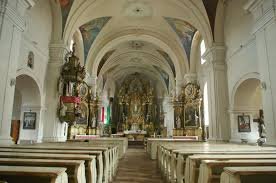
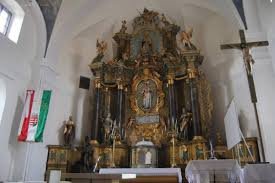
Photo sources: local sources
Three architectural periods in a single building
Saint Nicholas Church uniquely bears the traces of three architectural periods in a single body. Romanesque elements in the lower part of the tower, the Gothic door frame of 1498 at the tower entrance and the Baroque main facade and interior of 1756–1773 — together they testify to the medieval, early-modern and Baroque development of Gheorgheni. Few churches preserve continuity in such a tangible way.
Useful information
How to find
- Address: 9–11 Márton Áron Street
- Town: Gheorgheni
- County: Harghita
- GPS: 46.7223° N, 25.6034° E
Opening hours
- The church is open during services
- Sunday Masses held regularly
- The exterior can be viewed at any time
- Parish office by prior arrangement
What to see
- The 1498 Gothic door frame on the tower
- The Baroque main altar of 1780
- Baroque pulpit (the 4 Doctors of the Church)
- Stations of the Cross within the fortified wall
- The loopholed stone wall
Tip
- Church garden: there is also a modern playground!
- Open: 9:00 – 19:00
- Pedestrian town centre
- Near the Armenian Church