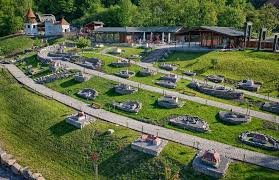
Seiche Bath
A resort and leisure centre belonging to Odorheiu Secuiesc, in the valley of the Salt Brook —
centuries-old mineral waters, the grave of "the greatest Székely" and the Székely gates museum, where "the gates speak through their ancient inscriptions".
The thermal bath with cloudy water
Seiche Bath (Romanian Băile Seiche) is a district of Odorheiu Secuiesc, lying 4 km north-west of the town in the scenic valley of the Salt Brook. It is at once a resort and leisure centre, a spa, a cultural pilgrimage site and a modern tourist adventure park.
According to ethnographers, the name "szejke" means "cloudy", and the bath was named after its greyish, sea-water-like healing water. The water is rich in iron, sulphur and carbon dioxide — hence its unusual colour.
Seiche has been known by this name since 1766. By 1850 there was already a wickerwork bathing pool here, which Orbán Balázs bought in 1871 and modernised: he built warm baths, inns and a hotel. Today only the caretaker house remains — the rest was demolished in 1941 when the main road was built. A cycle path links the site with Odorheiu Secuiesc.
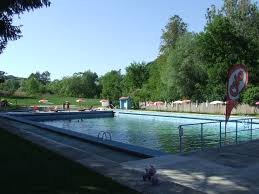 The healing springs of Seiche Bath · local source
The legacy of Orbán Balázs
 The tomb of Orbán Balázs a Borvízoldalban · helyi forrás
Baron Orbán Balázs of Lengyelfalva (1829–1890) — "the greatest Székely" — was a writer, ethnographic collector, historian, ethnographer, publicist, photographer, member of parliament and corresponding member of the Hungarian Academy of Sciences. He was born on 3 February 1830 in nearby Lengyelfalva and died on 19 April 1890 in Budapest.
His life work, the six-volume monograph "Description of Szeklerland from historical, archaeological, natural and ethnographic perspectives", was written here at Seiche — still the foundational work for understanding Szeklerland. In his will he bequeathed all his wealth to the Székely people.
According to his last wishes he was laid to rest here on his former estate, on the Borvízoldal slope. A curiosity: he was buried four times — due to the elements and the neglect of the burial ground, the memorial was rebuilt several times, but always in the same place, at Seiche Bath.
The current tomb with Székely grave-post (kopjafa) and half-relief, bearing the bronze portrait of Orbán Balázs, was built in 1969 to the designs of sculptor Orbán Áron of Odorheiu Secuiesc.
The open-air Székely Gates Museum
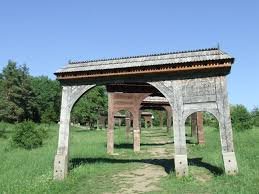
The path to the tomb of Orbán Balázs leads through a row of 15 carved Székely gates — one of Transylvania most remarkable open-air museums. Writer Sütő András called this row of gates "the gates of life and death".
The Székely Gates Museum was established in the 1970s — teacher and school inspector Kovács Mihály had 3 gates erected from 1973 on, and his work was continued by teacher Vofkori György. The exhibition operates under the care of the Haáz Rezső Museum.
Closest to the Orbán memorial stands the gate of Orbán Balázs himself — commissioned by Orbán Balázs himself in 1888, two years before his death, originally placed in front of his house. The gate has a dovecote on its front — Sütő András wrote: "plainly for life, with a dovecote on its façade".
The oldest gate is the 4th in the row — erected in 1818 in Fenyéd (Brădești) by Gergely János and his wife László Zsuzsanna. The row mainly features 19th-century gates from Brădești and Mărtiniș.
In 1984, Sütő András still wrote of only 5 gates — today 15 stand. After the change of regime the museum could be extended from the 10th gate onwards, and has been growing steadily since the founding wave of 1973.
"Approaching the tomb, when the feeling of reverence begins to render one silent, the gates speak through their ancient inscriptions. One must pass beneath five gates to reach the resting place of Orbán Balázs. The last — two years before his death — he himself had built. Plainly for life, with a dovecote on its façade. Doves, of course, do not nest in it."
— Sütő András, 1984The Mineral Water and Bath Museum
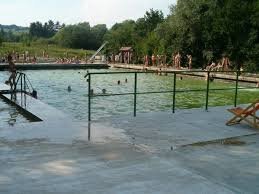 The Seiche Bath Mineral Water Museum · local source
The Mineral Water and Bath Museum at Seiche Bath opened its doors on 21 May 2008. It is a two-storey, 268-square-metre wooden building whose purpose is to present the mineral-water and bathing culture of Szeklerland.
The institution is run by the Haáz Rezső Museum and the Municipality of Odorheiu Secuiesc. The museum presents:
- The region mineral-water springs and their chemical features
- The tools of traditional Székely mineral-water transport
- The past of Seiche bathing life — with photographs and postcards
- Old mineral-water bottles and everyday objects
📚 Interesting fact: the plans had been ready for several years, but the flood of 23 August 2005 — which claimed 16 lives in the area — caused severe destruction. The iron bridge over the Seiche brook was swept some 15 metres away by the flood.
Sights of Seiche Bath
The tomb of Orbán Balázs
The monument with grave-post (kopjafa) and half-relief bronze portrait — by Orbán Áron (1969). One of the most famous cultural pilgrimage sites in Transylvania.
15 carved Székely gates
The gates of the open-air Székely Gates Museum — works from 1818 to the present day. The oldest is 207 years old!
Mineral Water Museum
A two-storey 268-m² wooden building presenting the mineral-water and bathing culture of Szeklerland. Thematic exhibitions all year round.
Mineral-water springs
The original healing waters with high iron, sulphur and carbon-dioxide content, after which the bath was named. Used for both drinking and bathing cures.
Mini Transylvania Park
Part of the complex: the only miniature park in Romania with 90+ Transylvanian fortresses and castles. (See dedicated detailed page!)
Insect Park
Next to the miniature park, a thematic exhibition presents the insect world through giant robotic models.
260 years in bathing culture
First written mention
The name "Seiche" is first mentioned in documents in 1766 — but the use of the healing waters is probably much older.
Wickerwork bathing pool
The first known bathing pool — a wickerwork, rudimentary facility, but already marking the start of organised bathing life.
Orbán Balázs buys and modernises it
Orbán Balázs bought Seiche and built a modern spa resort: warm baths, inns, a hotel. Here he wrote his life work, the six-volume "Description of Szeklerland".
Erection of the "Orbán Balázs gate"
Orbán Balázs had his own gate erected two years before his death — originally in front of his house, today the last gate before his grave. A front with a dovecote, once painted gold and blue.
Death of Orbán Balázs
The "greatest Székely" died in Budapest on 19 April 1890. According to his last wishes he was buried at Seiche — his grave is still here, after four reburials.
Demolition of the old buildings
When the main road was built, the old bath buildings, inns and hotel were demolished. From the Orbán Balázs era only the caretaker house remains.
The current tomb
To the designs of sculptor Orbán Áron, the tomb with grave-post (kopjafa) and half-relief featuring the bronze portrait of Orbán Balázs is completed.
Beginning of the Székely Gates Museum
Teacher Kovács Mihály erects 3 gates — the beginning of the open-air Székely Gates Museum. Vofkori György continued the work.
Devastating flood
On 23 August 2005, a devastating flood caused serious damage in the area — 16 lives were lost. The iron bridge over the Seiche brook was swept 15 metres away. The mineral water museum under construction also suffered great damage.
The Mineral Water Museum opens
On 21 May 2008, the Mineral Water and Bath Museum opens its doors — a two-storey, 268 m² wooden building.
Seiche Bath in pictures
Photo sources: local sources
Useful information
How to find
- Location: district of Odorheiu Secuiesc
- Distance: 4 km towards Praid
- GPS: 46.3263° N, 25.2678° E
- Cycle path from the town!
Opening hours
- Daily: 10:00 – 18:00
- In high season: 10:00 – 19:00
- Open all year round
- Peak traffic: July–August
Entrance tickets
- Adult: 40 RON
- Child/Senior: 25 RON
- Under 3 years: free
- Parking: FREE
Tips
- Barrier-free — accessible by wheelchair
- Read the Sütő András quotation
- Count the 15 Székely gates!
- Taste mineral water at the spring