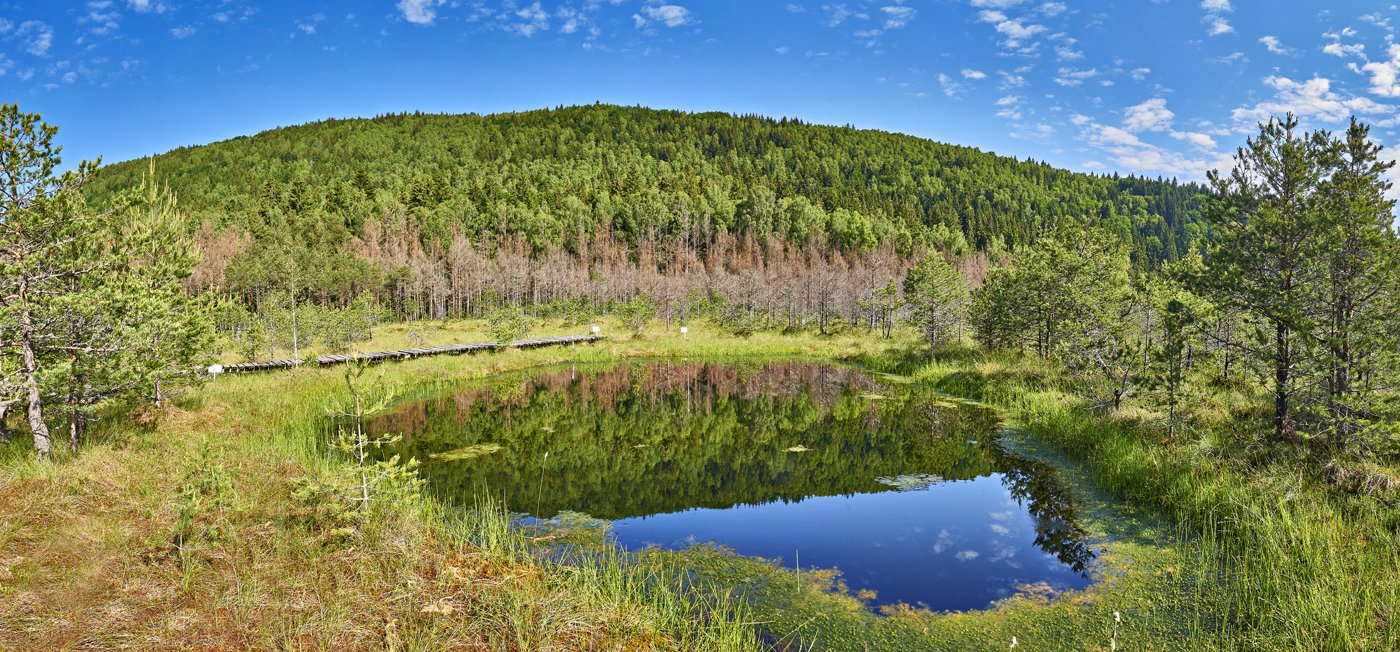
Mohoș Peat Bog
Guardian of Ice-Age rarities in the older crater of Ciomatu
at 1050 m altitude, near Băile Tușnad
Source: szekelyhon.ro
An Ice-Age time capsule
The Mohoș Peat Bog lies next to Saint Anne Lake, in an older crater of the Ciomatu (Csomád) Mountains, at 1050 m above sea level.
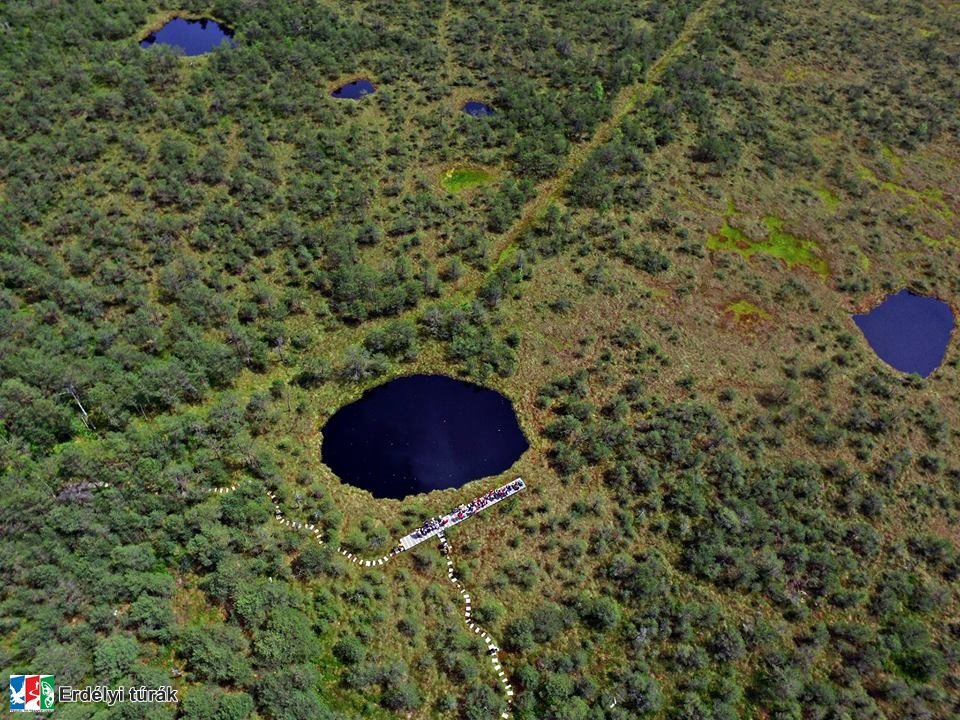
The 80-hectare bog formed through the gradual swamping of a former volcanic lake, at the bottom of which a peat layer up to 10 m thick — some 3 million cubic metres in total — accumulated over millennia.
Of the once-vast lake system, only 15 small ponds remain today — there were still 24 in 1963. The area is part of the Natura 2000 network and is a strictly protected ecological reserve.
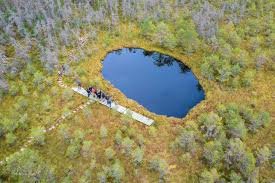 One of the surviving ponds of the bog · gyergyoalfalu.ro
A living Ice-Age museum
Owing to its strongly acidic (pH 3.8–4.1) and nutrient-poor soil, the bog behaves as an edaphic tundra that has provided refuge to rare plant species surviving from the Ice Age.
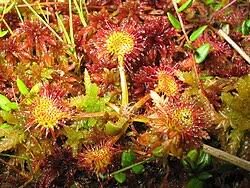
Round-leaved sundew
Drosera rotundifolia — Transylvania's only carnivorous plant. It supplements the nutrient-poor peat by trapping insects. The most peculiar and rarest species of the reserve.
Glacial woody remnants
Woody vegetation is represented by Ice-Age relicts: downy birch (Betula pubescens), dwarf birch (Betula nana) and Scots pine (Pinus sylvestris).
Sphagnum rarities
On the rich sphagnum (Sphagnum) carpet thrive botanical rarities: bog rosemary (Andromeda polifolia), bog bilberry, black bilberry and cowberry.
The secrets of the peat layer
The peat that has built up at the bottom of the bog has been accumulating for millennia and constitutes an exceptionally valuable ecological archive.
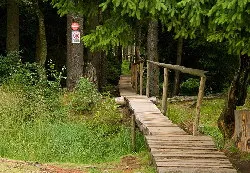
Danger! The boggy, soft peat soil can behave like quicksand. For the physical safety of visitors, the area may only be entered in the company of a qualified guide, along the constructed boardwalk.
The world of the bog
Before you set off
Permitted activities
- Guided tour with a qualified guide
- Nature photography from the boardwalk
- Birdwatching
- Botanical observation
Forbidden activities
- Independent visits are forbidden — only with a guide
- Stepping off the marked boardwalk
- Collecting or picking plants
- Dumping waste
How to get there
- From Băile Tușnad: approx. 10 km
- From Saint Anne Lake: approx. 1 km on foot
- From Bálványos Resort: approx. 4 km
- Park at the Saint Anne Lake car park
Safety
- Active bear habitat in the vicinity
- Avoid visits after dark
- The boggy ground is dangerous — do not step off the boardwalk!
- Group visits are recommended
Did you know?
The Mohoș Peat Bog was once a lake just like its neighbour, Saint Anne Lake — over millennia it gradually turned into a swamp.
The number of ponds was still 24 in 1963, but has now dropped to 15 — the bog is continuously drying out and shrinking.
The round-leaved sundew (Drosera rotundifolia) is Transylvania's only carnivorous plant — it makes up for the lack of nutrients by digesting insects.
The soft peat soil can behave like quicksand — visitors stepping off the boardwalk may sink into the mire.