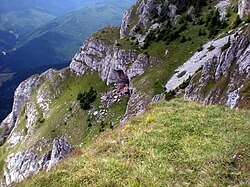
Hășmaș Mountains
Home of Lake Roșu and the Bicaz Gorges, source of the Olt and Mureș rivers —
with its 1792 m peak, one of Transylvania's most beautiful limestone ranges, of which Balázs Orbán wrote: "neither Switzerland nor Tyrol can show anything more beautiful".
Source: local sources
Transylvania's "Switzerland and Tyrol" in one
The Hășmaș Mountains (Hungarian Hagymás-hegység, historically Bárány-havas) form one of the most beautiful limestone ranges of the Eastern Carpathians — sitting on the border of Harghita and Neamț counties. Since 1990, the entire range has been a protected area of the Bicaz Gorges–Hășmaș National Park.
The range consists of rock formations built of crystalline schists (sedimentary rock). Its central mass is organised around two iconic peaks: Hășmașul Mare (1792 m), the highest point and the one that gives the range its name, and Piatra Singuratică (1608 m), a "mythical" rock tower that rises in solitary grandeur.
The range has two main parts: the easily accessible Lake Roșu–Bicaz Gorges area, reached by the paved main road, and the higher, subalpine zone of Piatra Singuratică and Hășmașul Mare. Here lies the range's most cherished natural treasure, the EKE mountain hut at 1504 m, built in 1932.
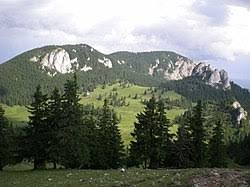 Summit panorama from Hășmașul Mare · local source
"Such a beautiful and radiant landscape that neither Switzerland nor Tyrol can show anything more beautiful."
Two peaks, two characters
Hășmașul Mare · 1792 m
The highest point of the range and the peak that gives it its name. At the summit, hikers are greeted by the cross erected by the Transylvanian Carpathian Society (EKE) — the first signpost was installed in 2009.
From the summit a dazzling 360° panorama opens up: to the west, the headwaters of the Olt and Mureș, with the Călimani, Gurghiu and Giurgeu Mountains beyond; to the north-east, past Lake Roșu and the Bicaz Gorges, the Bistrița Mountains.
From the summit, a trail leads down to the Poiana Albă (White Meadow) plateau, the most important alpine pasture of the range and a traditional shepherds' settlement.
Piatra Singuratică · 1608 m
Its Romanian name "Piatra Singuratică" means "Lonely Rock". The name fits perfectly: it consists of four rock pinnacles, yet forms a unit entirely independent of everything around it, soaring almost vertically toward the sky.
Although officially part of the Hășmaș range, Piatra Singuratică lives in hikers' imagination as a symbol of its own. A cross stands on its rocky summit, visible from far away.
It is suitable for rock climbing, and the most spectacular approach is the trail from Bălan — the former copper-mining centre.
Smaller massifs and sub-ranges
The Hășmaș Mountains nem egy egységes tömb, hanem több kisebb hegytömbökből és masszívumból áll. Mindegyiknek saját karaktere és turisztikai vonzereje van.
Suhardul Mountains
Suhardul Mic (1344 m) and Suhardul Mare tower above Lake Roșu. Here lies the famous Suhardul Mic via ferrata — the flagship attraction of the "outdoor capital of Transylvania".
Licaș and Ucigașu Mountains
The mountains surrounding the Bicaz Gorges: Licaș Peak, Piatra Altarului (1154 m), Făgetul Ciucului (1264 m), Piatra Mariei (1125 m). All of them a paradise for climbers.
Hășmașul Negru (Black Hășmaș)
Alongside Hășmașul Mare, the second-most important massif of the range. Its forest-covered ridges are home to the quiet southern hiking trails.
Piatra Roșie and Poiana Albă (White Meadow)
A limestone plateau on the northern slope of Hășmașul Mare, dotted with sinkholes (dolines). A classic karst phenomenon and the range's geological gem.
Hăghimașu Negru and Jidanu Mountains
Smaller massifs in the southern part of the range. Quieter, less-frequented areas — well worth exploring for those who want to escape the crowds.
Lapoșul and Surduc Mountains
The side-valleys of the Bicaz Gorges' tributaries. The Lapoșul stream forms a 25-metre three-step waterfall at the foot of Piatra Altarului. A wild, breathtaking world of gorges.
Treasures of the Hășmaș National Park
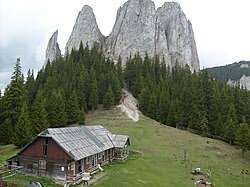 The EKE hut beneath Piatra Singuratică · local source
Within the Bicaz Gorges–Hășmaș National Park (in operation since 1990) lives a remarkable flora and fauna, shaped by unique limestone habitats.
Protected animals: chamois, lynx, brown bear and wolf — also found elsewhere in the Carpathians — together with the rare capercaillie, native here.
Protected plants: edelweiss (the park's symbol), lady's slipper orchid, gentian, globeflower. In the valley of the Bicaz stream that crosses the park grows the Bicaz milk-vetch — an endemic plant found nowhere else in the world.
The slopes are covered by vast coniferous forests dotted with clearings, alpine pastures and hayfields. The steep limestone walls bear sparse yet richly varied vegetation.
Hike to the summit of Hășmașul Mare
The classic route starts from Bălan and leads up to the summit via the Pârâul Frumos (Beautiful Stream) valley. Manageable with average fitness, though the upper sections are steep.
Start from Bălan
The hike starts from Bălan — once the largest copper-mining centre in the region. The Pârâul Frumos valley offers easy walking past cool springs, lush meadows and pine forests reaching toward the sky.
EKE mountain hut
The mountain hut in the shadow of Piatra Singuratică, built in 1932 by the Transylvanian Carpathian Society. It houses the information office and the mountain rescue base. Hiking time: 2.5–3 hours on average.
Summit of Piatra Singuratică
The rocky summit of the "lonely stone" close to the hut. At 1608 m, crowned by a cross, it offers a breathtaking view of both the Bicaz Gorges and Hășmașul Mare.
Hășmașul Mare summit
The highest point of the range. Here stands the EKE cross and the most panoramic view of the whole range opens up. The Poiana Albă plateau and the Călimani, Gurghiu and Giurgeu Mountains are all visible from here.
Where the Olt and Mureș are born
The Hășmaș Mountains a Kárpát-medence egyik legfontosabb vízválasztója: két nagy folyó forrását is itt találjuk, és a hegység lényegében ennek a vízválasztónak a magaslata.
Source of the Olt
The Olt rises on the south-western slope of the Hășmaș Mountains. From there it begins its long journey across the Carpathian Basin until it joins the Danube in Romania. Its headwaters can be clearly identified from the summit of Hășmașul Mare.
Source of the Mureș
The Mureș rises on the western slope of the range, near Fekete-Rez peak. From there it flows westward through Toplița, Târgu Mureș and Arad to join the Tisza in Hungary.
The range in pictures
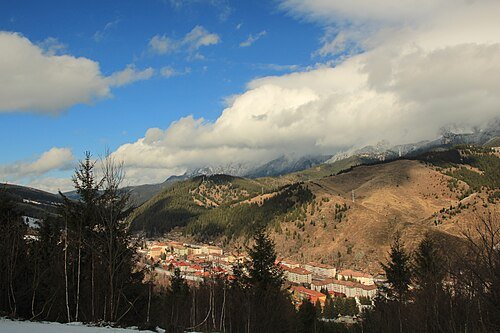
Photo sources: local sources
Before you set out
What you can see
- Hășmașul Mare summit (1792 m)
- Piatra Singuratică, the "lonely rock" (1608 m)
- EKE mountain hut (since 1932)
- Poiana Albă alpine pasture
- Protected animal and plant species
Best time to visit
- June–September: safest
- Winter hiking only with proper gear
- Spring: wet after snowmelt
- Autumn: glorious colours, fresh air
- Always be prepared for storms!
How to get there
- From Bălan: the classic route
- From Lake Roșu: heading west
- From Miercurea Ciuc: about 60 km to Bălan
- From Gheorgheni: 40 km
- GPS: ~46.673° N, 25.82° E
Hiking gear
- Sturdy hiking boots (mandatory!)
- Rain jacket, warm layer (changeable weather)
- Map, GPS, phone charger
- At least 2 litres of water, energy bar
- Emergency reserve: first-aid kit, blanket
Did you know?
The Hășmaș Mountains régi magyar neve „Bárány-havas", mert az évszázados pásztorhagyomány szerint a hegység legelőit főleg juhokkal és bárányokkal hasznosították. A pásztorszállások ma is működnek a Fehér-mező fennsíkján.
Hășmașul Mare is built of crystalline schists — a sedimentary rock belonging to the central, so-called crystalline-Mesozoic zone of the Carpathians. It is the middle one of the three main geological units of the Carpathians.
The EKE mountain hut was built in 1932 by the Transylvanian Carpathian Society and has been in operation for more than 90 years. It also houses the mountain rescue base, which saves the lives of hikers in the area.
On the limestone plateau of Piatra Roșie–Poiana Albă a classic karst phenomenon can be seen: a multitude of sinkholes (dolines). These natural depressions were formed over hundreds of thousands of years by the dissolution of limestone.