Ghimeș Csángó people
On the eastern edge of Harghita County, in the valley of the Trotuș river, lives one of the most distinctive Hungarian ethnographic groups — the guardians of an archaic world whose centuries-old traditions remain vividly alive to this day.
Who are the Ghimeș Csángós?
The Ghimeș Csángós live on the borderlands of Harghita and Bacău counties, in the three principal settlements of the Ghimeș valley — Lunca de Sus, Lunca de Jos and Ghimeș-Făget. They settled here along the Trotuș river in the 17th–18th centuries, descended from Székelys who came partly from Ciuc and partly from Háromszék (Trei Scaune) and adapted to the way of life shaped by alpine shepherding and frontier guard service.
Owing to their geographical isolation, they form a true linguistic and cultural island: their archaic Hungarian dialect preserves to this day medieval words, melodic turns and elements of dress that have long since disappeared from other parts of the Hungarian-speaking Carpathian Basin.
🎻 The world-famous folk music of Ghimeș
The music of Ghimeș is one of the most precious treasures of Hungarian folk music. The duo of its two characteristic instruments — the fiddle (hegedű) and the gardon (a cello-like stringed instrument that is struck rather than bowed, used as a percussion instrument) — creates a sound so unique that it can be heard nowhere else in the world.
The dance suites (jártatós, kettős, csárdás, fast csárdás) and the lamenting "keserves" tunes remain part of the living tradition today. The Ghimeș musicians — Zerkula János, Halmágyi Mihály and their pupils — are known around the world. The dance houses of Miercurea Ciuc and Budapest often learn directly from them.
👗 The vividly coloured Csángó folk costume
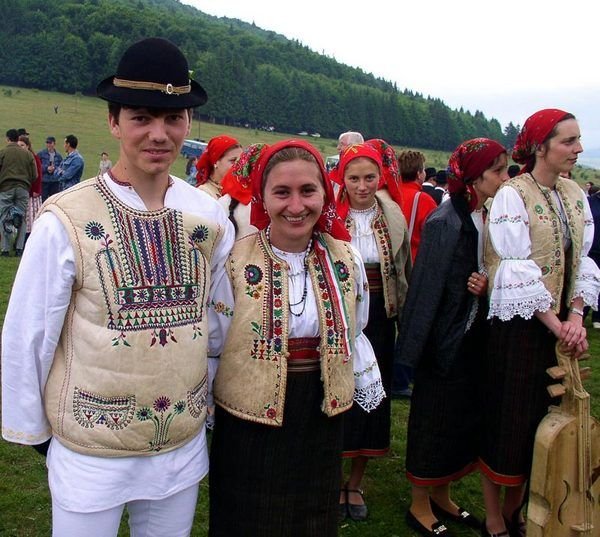
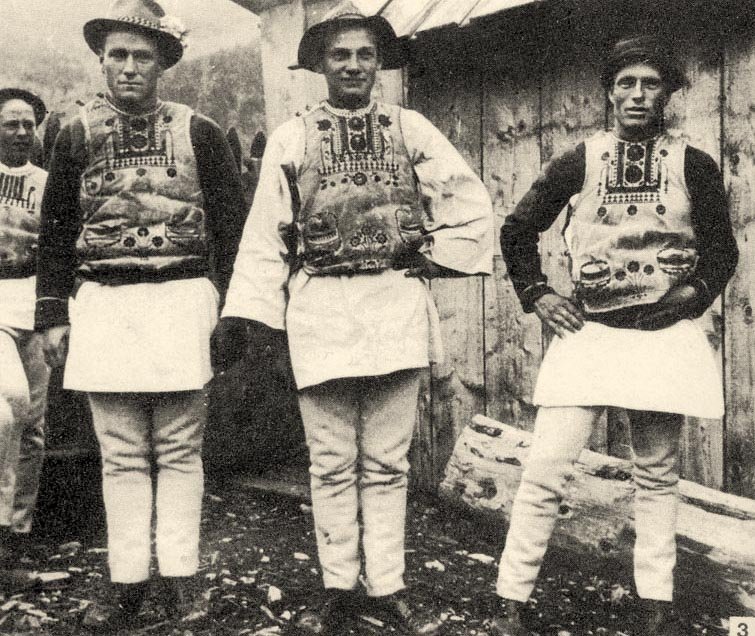
The Ghimeș Csángó costume is a striking sight: the foundation of the women's dress is the knitted, flower-decorated muszuly (skirt), with a beaded headdress, an embroidered blouse and the characteristic bokorugró (bush-jumper) skirt. The men wear white woollen trousers, a dark waistcoat (lájbi) and a curl-brimmed hat (pörge kalap).
The folk costume is still worn today on traditional holidays, at weddings, pilgrimages and dance houses — it is not a museum object but a living marker of identity.

🏔️ The millennial border and alpine life
Through the Ghimeș valley runs the former Hungarian–Romanian frontier, and earlier the eastern border of the Kingdom of Hungary — the so-called "millennial border". At Ghimeș-Făget the old frontier guard barracks still stands, together with the ruins of the Rákóczi Fortress, one of the oldest defensive points of the Carpathians' eastern marches.
For centuries, the Csángó way of life has rested upon alpine farming: shepherding sheep and cattle on the high pastures, the traditional production of dairy products (urdă, cheese, sheep's curd), the gathering of medicinal plants and household crafts. This sustainable, nature-bound way of life remains a hallmark of the region — and at the same time one of the most valuable offerings of local ecotourism.
⛪ The Csángó pilgrimage to Șumuleu Ciuc
The centuries-old pilgrimage of the Ghimeș and Moldavian Csángós is one of the most moving moments of the Pentecost Pilgrimage at Șumuleu Ciuc. They arrive at dawn in vividly coloured folk costume, singing their traditional chants, and cross the eastern boundary of Miercurea Ciuc bearing with them the ancient folk music of the highlands.
For the Csángó communities, the pilgrimage is also a centuries-old symbol of the preservation of Catholic identity and the Hungarian mother tongue.
📚 What does it mean to come to know the Csángós?
A visit to Ghimeș is not simply a tourist outing, but an encounter with a living cultural heritage. The dance houses, the traditional farmsteads, the pilgrimages and the everyday hospitality are all part of a world worth discovering slowly, with respect and openness.
The UNESCO Convention for the Safeguarding of the Intangible Cultural Heritage also draws attention to the importance of preserving such communities — and Harghita County is a singular gateway to this world.
Key facts
Settlements of Ghimeș
When to visit?
Experience tips
🎻 Take part in a dance house
🐑 Visit a shepherd's hut (stână)
🏞️ Hike to the millennial border
🍯 Taste local honey and cheese
🏰 Visit the ruins of the Rákóczi Fortress
🎭 Discover the Ghimeș valley in person!
Ghimeș Csángó culture comes most fully to life through personal experience. Plan your journey, discover the dance houses, the shepherd's huts and the alpine landscapes — an authentic adventure that will not let you go!
Trip planner