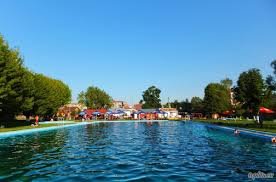
Urmánczy Bath
Toplița's historic thermal bath on the banks of the Mureș —
200 years of history, Hungarian-Armenian noble heritage and a "sparkling" pebble pool
Source: urmanczy.ro
In the heart of town, on the banks of the Mureș
Urmánczy Bath lies close to the centre of Toplița and the railway station, on the right bank of the Mureș, only a few metres from the river. Sitting at 654 metres above sea level, the bath's carbonated mesothermal mineral water is one of the most valuable natural treasures of the Toplița Basin.
Its main draw is the 50×20-metre Olympic-sized swimming pool — the region's largest thermal-water pool — where 26–27 °C warm mineral water flows. The bath also has a smaller, 1.4-metre-deep adventure pool, heated by natural springs rising from its bed — the water's high carbon-dioxide content produces champagne-like bubbles, gently tingling the skin.
The water's quality and healing effects have been known since the 18th century — according to the information board on site, its composition is comparable to that of the Gellért and Rudas Baths in Budapest.
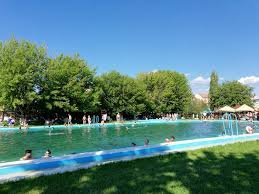 The Olympic pool and the bath grounds · urmanczy.ro
From Lake Urmia to Toplița
The Urmánczy family's origin story reads like a novel: the Hungarian-Armenian noble family took its name from the salt-water Lake Urmia in former Persia, now Iran — from there they fled Armenia, escaping the Seljuk Turkish attacks.
17th century · Lemberg
In the 17th century the family lived in Lemberg (Lviv), where they were elevated to baronial rank. From there they settled in Moldavia, mainly in the town of Roman (today in Romania).
1830–1836 · Toplița
The Urmánczys moved to Toplița between 1830 and 1836. They started in general trade, later bought up forests — and became the region's leading entrepreneurs through rafting and logging.
Nándor Urmánczy
The family's best-known member, 1868–1940, was born in Toplița and is also buried here. For sixteen years (1902–1918) he served as the district's member of parliament — representing Romanians and Hungarians alike.
200 years of the bath
The history of Urmánczy Bath is rooted in the legacy of two noble families — the Counts Lázár of Lăzarea and the Hungarian-Armenian Urmánczys — and the political upheavals of the 20th century also left deep marks on it.
The bath originally belonged to the Lázár Counts of Lăzarea. In 1818 the Lázárs built the first elegant entrance and four changing rooms. By 1835 a large carved-wood veranda stood at the entrance, with separate pools for men and for women, surrounded by cabins.
Around 1870 the Urmánczy family bought the bath from the Lázárs. A park full of walkways connected the family's mansion to the bath. After the 1932 flood it was rebuilt, and today's Olympic-sized pool was laid out around 1940.
In 1948 the communist regime nationalised it and renamed it "Youth Lido" (Ștrand Tineretului) — a name the locals never accepted. After the fall of communism it became neglected, the town's rubbish dump, with several tonnes of waste tipped into the pool.
After lengthy legal proceedings, the Urmánczy descendants recovered the bath. The new owner, Kálmán Szabó, and his wife Terka reopened it on 29 June 2008. They cleared tonnes of rubbish from the pool, put up new fencing and reinforced the Mureș bank with concrete.
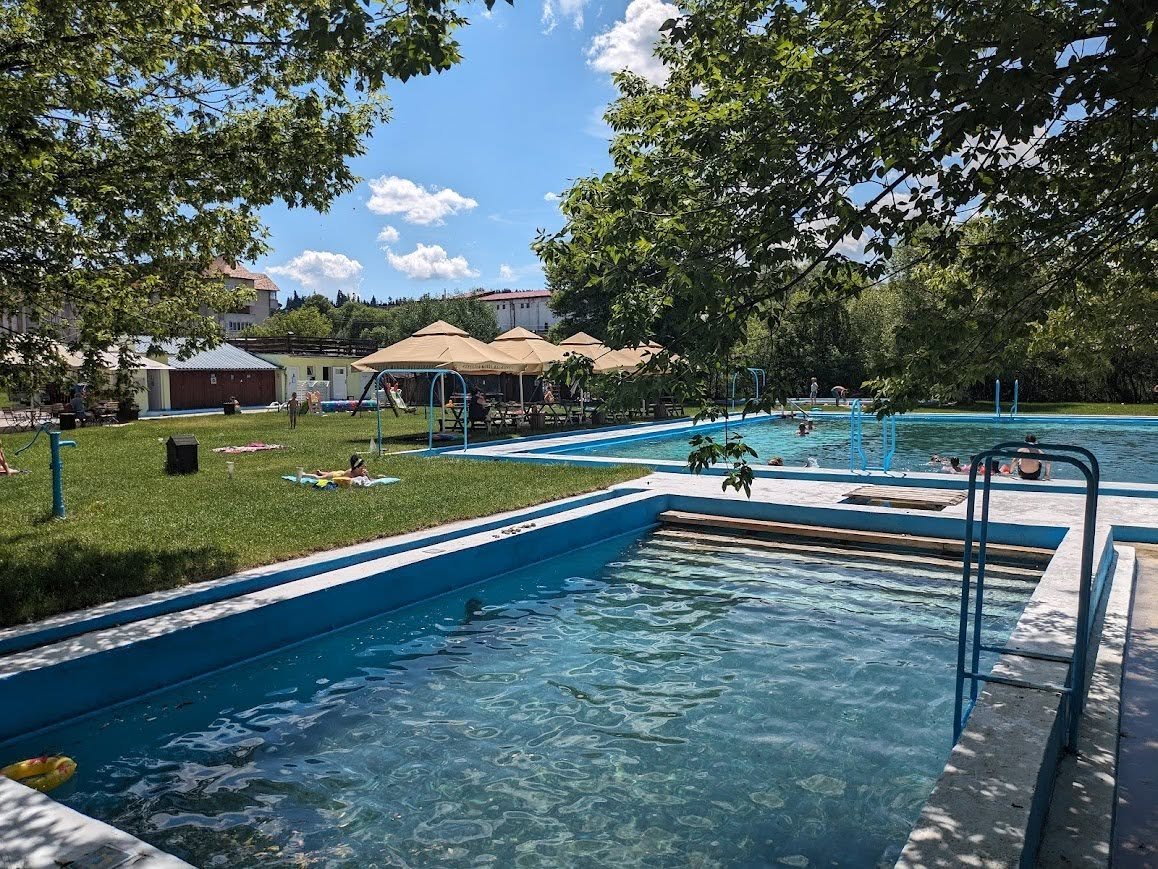
The bath's pools and experiences
The bath welcomes visitors with numerous pools and services — from active swimmers to families with small children, everyone will find their place.
The region's largest thermal-water pool, where the water is constantly renewed, so there is no chlorine smell. Since the bath is rarely crowded, it is excellent for swimming training and serious exercise. The 26–27 °C water is pleasant all season.
A real rarity: in one of the bath's small pools, natural springs rise from the bed, warming the pebbles on the bottom. The water's high carbon-dioxide content creates champagne-like bubbles — pleasantly tickling the skin.
A small crescent-shaped paddling pool for babies and a larger, deeper children's pool for kids over 3. On the grounds there is also a playground with a sandpit, swing, climbing frame and slide.
On the bath's grounds there is a cosy beer garden and garden terrace, where guests can order craft beers, cocktails, lemonade and iced coffees (frappé). Hungarian-style dishes: mici (Romanian skinless sausages), grilled meats.
Before you set out
What does the bath offer?
- 50×20 m Olympic pool
- Sparkling adventure pool (heated pebbles)
- Baby paddling pool and children's pool
- Playground, with lots of toys
- Beer garden, garden terrace, Hungarian cuisine
Useful information
- Phone: 0756 118 479
- Web: urmanczy.ro
- Location: Toplița, near the railway station
- Continuous water exchange, chlorine-free
- Family-friendly venue in the summer months
How to get there
- From the railway station: 5-minute walk
- From the centre of Toplița: 5 minutes by car
- Located on the right bank of the Mureș
- Road signs in town help you find it
- GPS: ~46.9046° N, 25.3534° E
Health notes
- If you have a heart condition, medical consultation is recommended
- Pregnancy: only with medical clearance
- High blood pressure: shorter bathing time
- One bathing session: max. 20–30 minutes
- In case of skin inflammation, do not enter the water
Did you know?
Urmánczy Bath's 50×20-metre Olympic pool is the region's largest thermal-water pool — exactly the size of a competition swimming pool (50 metres long).
The bath's water has a composition similar to that of the Gellért and Rudas Baths in Budapest — mesothermal, carbonated and rich in mineral salts. The information board at the bath confirms this.
The special thing about the "sparkling pool": the natural springs rising from its bed not only warm the water but also heat the pebbles on the bottom — as if bathing inside a giant champagne glass.
In 1923, after the land reform, the Urmánczys lost 1,000 hectares of their 10,000-hectare forest — and in 1948 the rest was nationalised as well. The bath was only partly recovered, after a long legal battle.