Patkó Square
The distinctive horseshoe-shaped main square of Odorheiu Secuiesc — home to the Iron Székely Monument, 5 historic coats of arms,
imposing school buildings and one of Transylvania's finest open-air sculpture collections.
The heart of the town — the Patkó
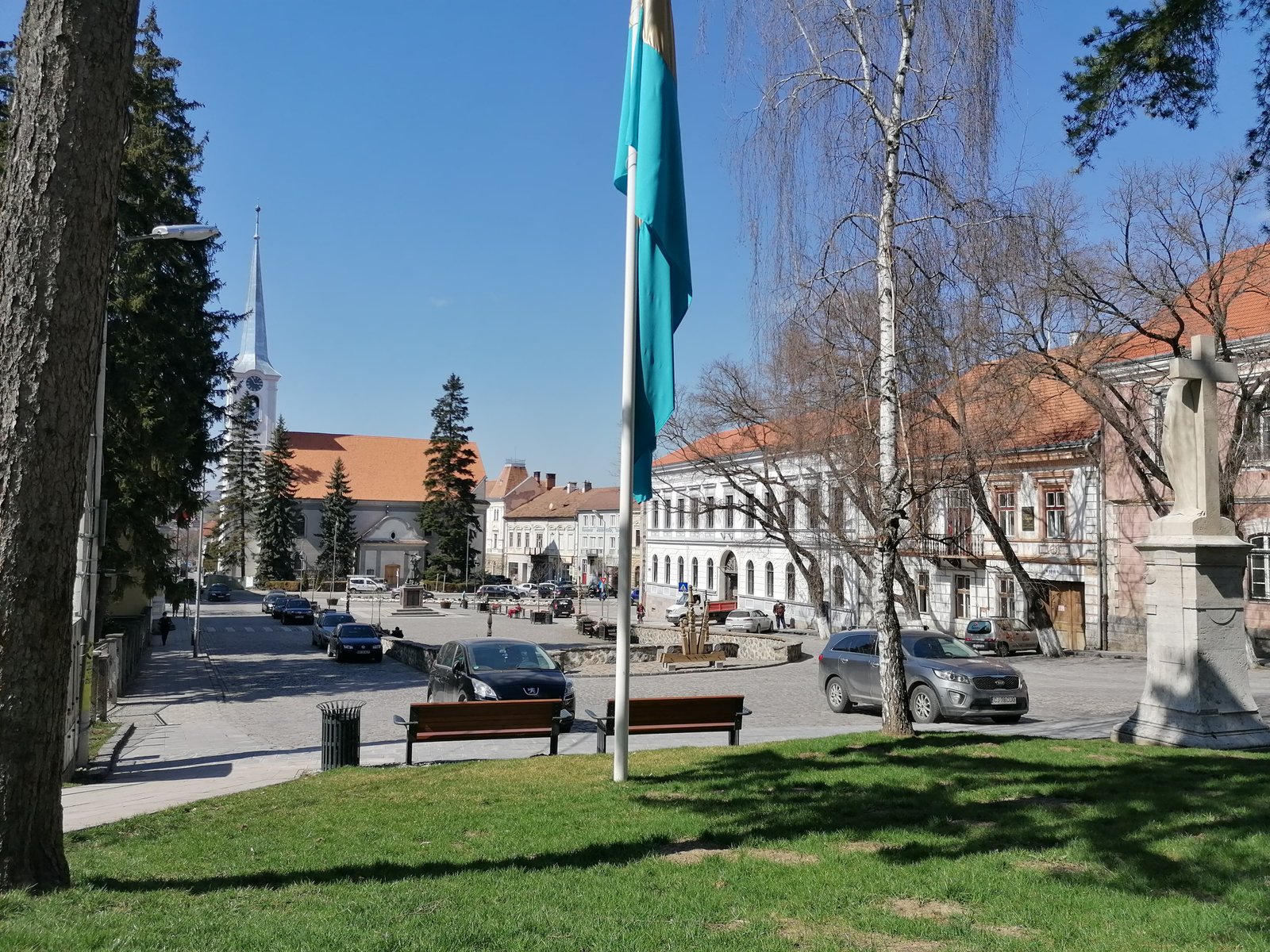
Patkó Square — officially named Márton Áron Square — is the most important central square of the historic centre of Odorheiu Secuiesc and one of the town's best-known landmarks. The promenade, known to locals simply as the "Patkó" (Horseshoe), takes its name from the distinctive horseshoe shape that emerged during 19th-century town planning.
The square is not only an architectural rarity, but also a place of historical and cultural significance. Imposing historic buildings line the area: old town palaces, bank buildings and public institutions — all of them witnesses to the town's rise of the burgher class. The curve of the square is framed by the buildings of two leading historic schools: the Roman Catholic Tamási Áron High School and the Reformed College.
Right next to the Patkó lies City Hall Square (the former Lower Market Square), so the two squares together form the very core of Odorheiu Secuiesc's historic centre — surrounded by café terraces, shops and banks.
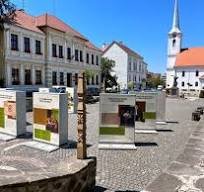 Panorama of the horseshoe-shaped square · local source
The Iron Székely — one statue, two lives
The Iron Székely is the most iconic monument of Odorheiu Secuiesc — erected during the First World War in memory of the fallen heroes of the 82nd Székely Infantry Regiment. The statue has a truly extraordinary story: the original 1917 work was demolished during the occupation, but the townspeople re-erected it 83 years later, in 2000, this time in bronze.
The original carved statue
It was unveiled on 8 December 1917, on what was then Deák Square. Because of the metal shortage caused by the state of war, a bronze statue could not be cast, so Sergeant István Erdélyi designed it from oak wood — his collaborators were soldiers of the 82nd Székely Infantry Regiment: Squad leader Ottó Herman, private Jenő Sipos and corporal Géza Rózsa. The statue was covered with steel scales — hence the name "Iron Székely". Above it stood a four-columned pagoda with a shingled roof.
Demolition
The incoming Romanian troops tore the statue down after barely two years, shot at it twice and then forced the locals to saw it apart. Only the pedestal remained — veterans kept gathering there for decades to honour the fallen.
National flag memorial
Under Hungarian rule a national flag memorial with a Székely grave-post (kopjafa) was placed on the surviving pedestal, and the old pagoda was dismantled. This is the origin of the term "national flag memorial".
The new bronze Iron Székely
On 15 March 2000, the anniversary of Petőfi's birth, the work of János Szabó, a sculptor from Odorheiu Secuiesc, was unveiled — a 260-cm-high bronze statue. A fragment of the original inscription can still be read on the pedestal: "Bring edelweiss from the Harghita — the Székely heroes are immortal!". On the eastern and southern sides of the pedestal, black marble plaques bear the names of the heroes who died in the Second World War.
Symbols of the square
Iron Székely statue
The bronze soldier re-unveiled in 2000 — in memory of the heroes of the 82nd Székely Infantry Regiment. The central symbol of the square and an everyday meeting point.
5 historic coats of arms
Set into the inner curve of the horseshoe, carved in stone: the coats of arms of Udvarhely County, Odorheiu Secuiesc, Hungary, Transylvania and Pestszentlőrinc.
Tamási Áron High School
The present building of the Roman Catholic Main High School, founded in 1593, was built in 1910 in eclectic Art Nouveau style — one of the dominant buildings of the square.
Reformed College
The building of the Baczkamadarasi Kis Gergely Reformed College, founded in 1670, is the other prominent school institution of the square.
Statue of Balázs Orbán
The "greatest Székely" — writer, ethnographer and photographer, corresponding member of the Hungarian Academy of Sciences. László Hunyadi's full-figure statue was unveiled in February 1995.
Central fountain
Áron Orbán's 1956 design won the public sculpture competition. The fountain has been one of the square's atmospheric features ever since.
The Patkó in pictures
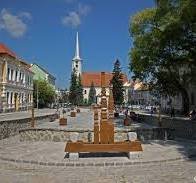
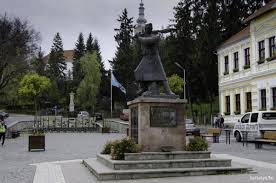
Photo sources: local sources
The most Hungarian regiment of Transylvania
The 82nd Székely Infantry Regiment was the most Hungarian Transylvanian regiment of the First World War — its soldiers were recruited from Udvarhely and Csík counties. The regiment's heaviest battles took place in August 1917 in the Oituz Pass, on the heights of Măgura Cașinului, where the Székely soldiers held their positions and repelled the advancing Russian and Romanian troops.
The Iron Székely is not merely a monument but a symbol of the identity of the Székely community — a unity of past, art and remembrance. It belonged among the "statues of national sacrifice": donors could hammer iron nails and steel scales into the wooden statue in exchange for a charitable contribution.
A community space to this day
Patkó Square is not merely a monument but a living urban space: it is lined with cafés, restaurants, shops and bank branches. It regularly hosts open-air exhibitions, city festivals, cultural events and seasonal fairs.
Cultural events
City festivals, concerts and open-air exhibitions with programmes that change with the seasons. The square's acoustics are also ideal for small concerts.
Seasonal fairs
Christmas market, Easter market, craft fairs — the Patkó takes on a new face with every season, always hosting another event.
Cafés and terraces
Around the square, several cafés and bistros set out their terraces — Junior, Menta, Zsebkávézó, Kalapos kávézó, Luna pâtisserie — an excellent choice for a morning coffee or an evening drink.
Birthday of Balázs Orbán
Every year, the square hosts the anniversary of Balázs Orbán's birth (3 February 1830) — with wreath-laying, speeches and cultural programmes.
Useful information
How to find it
- Address: Piața Márton Áron
- Town: Odorheiu Secuiesc 535600
- GPS: 46.3049° N, 25.2926° E
- Accessible via the 13A main road
Parking
- Weekdays 8:00–17:00: paid (TPark)
- Weekends and evenings: free
- Several car parks in the surrounding streets
- On busier days it is worth arriving early
Opening hours
- Always open — public open space
- Entry: FREE
- Best light conditions: afternoon
- Winter atmosphere: Christmas market
Tips
- Read the inscription on the Iron Székely's pedestal!
- Count the 5 coats of arms
- Walk past the statue of Balázs Orbán
- Try the surrounding cafés