Corund (Korond)
Transylvania's foremost folk-arts centre at the foot of Mount Firtuș — where pottery has been alive since the 17th century,
and where Romania's largest aragonite deposit is hidden.
The crown of Salt Country
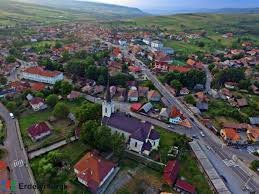
Corund (Hungarian Korond) is a Transylvanian village in Romania's Harghita County — the most notable settlement of Salt Country (Sóvidék) and its hub for folk arts, tourism and culture. The village lies 29 km northwest of Odorheiu Secuiesc, at the foot of Mount Firtuș, in the valley of Corund Creek, along road DN13A.
Corund is a large commune: it includes the so-called "tízes" units (Székely military decades) — the villages of Atyha (Atia), Kalonda, Pálpataka and Fenyőkút. This five-village microregion is part of Salt Country, neighbouring Praid and Sovata.
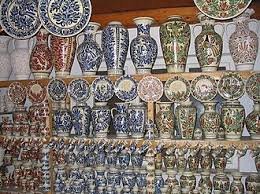
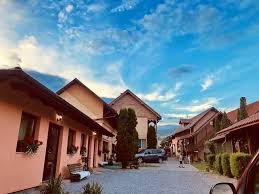
The village is known worldwide for its folk pottery, living craft traditions and signature glazed ceramics. A permanent open-air market runs along the main street, where one can buy vessels and decorative pieces ornamented with traditional motifs.
 A Corund potter at work · local source
The village of military decades
Corund has been a Hungarian, Székely settlement for more than 700 years — the first written mention dates from 1333. The village's layout faithfully preserves the Székely military tradition: it was divided into ten parts, the so-called "tízes" (decades), arranged around the village centre.
The "tízes" system is the ancient legacy of Székely military organisation — each decade was a military unit charged with border defence. Corund's street names preserve this memory to this day: Huszár, Nyilak, Felszeg, Alszeg, Sóút, Lőrinc Márton and so on.
In the 18th century the decades belonging to Corund — Atyha (Atia), Kalonda, Pálpataka and Fenyőkút — gradually became independent villages. In his work "Description of Székely Land", Orbán Balázs remembered Atyha thus:
"On the gracefully shaped summit of Fiastető Peak, Atyha thrones like a proud eagle's nest — our homeland's most beautiful and highest-lying village."
The great Székely uprising of 1562 was a turning point — after its defeat, the free right of salt use was abolished for the Székelys of Salt Country. This pressure brought about the rise of pottery — the soils of Salt Country were not enough to live on, so worked clay became the foundation of livelihood. Corund's pottery was born of the Székely strategy of survival.
Corund pottery — 460+ years of tradition
 Corund's open-air ceramics market along road DN13A · local source
The roots of Corund pottery reach back to the second half of the 1500s — after 1562, when the Székelys of Salt Country learned ceramics-making out of necessity. The name has two possible explanations: from the Hungarian "korom" (soot, with the -d suffix), or from "korong, korongolás" (the potter's wheel and the act of throwing), pointing to the very essence of the living tradition.
By 1893 there were already 367 potters working in the village! Glazed ceramics spread at the end of the 19th century. Corund's products were first sold in the surrounding regions, then spread beyond the Carpathians.
1893: the School of Stone and Pottery Trades was founded in Odorheiu Secuiesc, where Corund potters enrolled their children. Adults too attended eight-month courses to refine their craftsmanship.
The living crafts of Corund
Pottery (ceramics)
The main craft — dozens of family workshops. Signature red-white-green colours, floral and geometric motifs. Centuries of generational knowledge.
Tinder fungus craft
The Székelys of Corund are great masters of tinder-fungus craftsmanship. From the tinder mushroom they make caps, hats, bags and decorative pieces — a tradition unique to Transylvania!
Wood carving
The village is dotted with many fine Székely carved gates — in front of the Hungarian-language secondary school stands the "Mother tongue, our fortress" monument, a masterpiece of wood carving.
Aragonite processing
1909–1939: the polishing workshop of the Czech teacher Vencel Knop. Aragonite is known as the "Székely diamond" — decorative objects and church holy-water fonts were carved from it.
Experience workshop
In several workshops anyone can try the potter's wheel — an interactive learning experience, an ideal programme for families.
Corund horse-cart rides
In the heat of summer, horse-drawn cart trips set out around the village and Salt Country — a living folk mode of transport in the 21st century.
Snail Hill — Romania's largest aragonite deposit
On the northern edge of Corund, at 643 m altitude, lies Snail Hill (Csiga-domb; locally Rakodó Hill) — a carbonate spring-cone complex, one of Europe's most singular geological phenomena. It is Romania's largest aragonite deposit, stretching over some 8 hectares.
The mineral that forms here is aragonite: a whitish-yellow, orange, sometimes bluish carbonate stone, named after the Aragón River in Spain, where it was first identified in 1788. It is often also called the "Székely diamond".
Its singularity is that the surface "grows" before our eyes — the salty, carbonated water welling up from below still deposits aragonite crystals, layer upon layer. Few places in Europe allow one to witness such a phenomenon live.
Since 1980 a nationally protected geological reserve. The nature trail laid out in 2011 and renovated and modernised in 2017 guides visitors along walkways — with information panels and viewpoints.
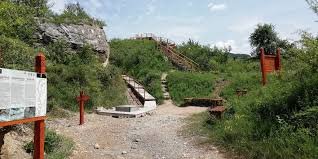 The Snail Hill nature trail and aragonite formations · local source
The fate of Snail Hill
Aragonite first identified
In Spain (around the Aragón River) — the carbonate stone takes its name from here.
Arrival of Vencel Knop
The Czech-born teacher, trained at the Zlatna Stone Sculpture and Polishing School, moved to Corund and founded the modern Aragonite Polishing Workshop.
Golden age of aragonite working
Corund aragonite products were shown even at the Paris World's Fair. Holy-water fonts were crafted for the Roman Catholic church of Corund.
The tragedy of "dynamite blasting"
The communist regime placed quantity of production above aesthetics, accelerating extraction with dynamite blasting. The result: the snail-shell shape was lost, and the spring's yield fell at least tenfold.
Geological protection
Snail Hill became a nationally protected geological reserve — the natural treasure finally received proper safeguarding.
Nature trail laid out
Walking paths were established on Snail Hill, with information panels for visitors.
Reopening of the Unicum salt bath
The folk Unicum salt bath at the foot of Snail Hill was rebuilt through local initiative and effort — it still operates today.
Trail renovation
The nature trail was upgraded — with safety railings, benches and information panels. Usable year-round, winter and summer alike.
Europe's only aragonite museum
The Knop Vencel Aragonite Museum is housed in the building of the former aragonite polishing workshop, directly opposite the Snail Hill nature reserve. It is Europe's only aragonite museum — one of Romania's most distinctive mineralogical collections.
Over 200 objects are on view: decorative vases more than a century old, jewellery and everyday objects, some of which reached the Paris World's Fair. At the interactive sessions you can try aragonite polishing for yourself and make your own keepsake!
📍 Address: DN13A 1469/b, Corund · ⏰ Open: Tue–Sun 10:00–14:00 and 15:00–17:00 (closed Mondays) · 📞 +40 745 627 914 · 🗓️ Season: regular hours 1 May – 1 November.
Corund mineral waters and salt bath
Diómál Spring
Ferruginous medicinal water, a renowned curative borvíz of the village.
Cseredomb Spring
Locally nicknamed "Fingó borvíz" — carbonated water in the Snail Hill area.
Árcsó borvíz spring
In the northern part of the village, near the Árcsó inn.
Erzsébet Spring · Ancient Spring · Dió
Further Corund mineral waters — many springs are passed down across generations in the village.
Unicum salt bath
At the foot of Snail Hill — operating again since 2015. A traditional folk salt-water bath.
A 290-year-old document
A letter from Count Sándor Teleki to his brother, mentioning Corund healing water — the historical roots of local bathing culture.
Corund in pictures
Image sources: local sources · Excel database
Useful info
Location
- Village: Corund, Salt Country (Sóvidék)
- GPS: 46.4870° N, 25.1780° E
- Route: road DN13A
- 11 km from Praid, 18 km from Sovata
When
- Open year-round
- Main season: May – September
- Aragonite Museum: 1 May – 1 Nov.
- Open-air market: daily in season
Worth picking up
- Authentic Corund pottery
- Decorations made from tinder fungus
- Aragonite souvenir
- Local honey, cheese, pálinka
Tips
- Plan a full day!
- Stop into a workshop for a live demo
- The Snail Hill nature trail is a must
- Combine with Mini Transylvania Park