Haáz Rezső Museum
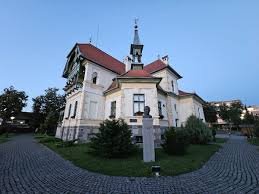
In the Haberstumpf Villa — the material and spiritual heritage of Székely Land, in a venerable eclectic building from the early 20th century,
where the genius of János Bolyai meets the treasures of Székely folk art.
The material and spiritual heritage of Székely Land
The Haáz Rezső Museum in Odorheiu Secuiesc is one of the region's most important cultural centres, preserving the material and spiritual heritage of Székely Land in the restored, venerable Haberstumpf Villa. The institution is at once an ethnographic, local-history, art and natural-history museum — a centre for collecting, processing and publicly displaying the cultural legacy of the historic Udvarhely Seat.
The museum is named after drawing teacher Haáz Rezső (1883–1958), who assembled an ethnographic collection of over 4,000 items in the first half of the 20th century. His work laid the foundation of today's museum — the collection has been open to visitors since 1913 and has operated as a state museum since 1950.
The museum also functions as a community space: it regularly hosts exhibition openings, concerts, children's programmes and the now-traditional Night of Museums in the Haberstumpf Villa and museum garden.
 The Haberstumpf Villa, a múzeum otthona · helyi forrás
The Haberstumpf Villa — német eklektika Székelyföldön
The villa was designed and built by Károly Haberstrumpf, a German architect from Bistrița, in the early 20th century. The building rises in characteristic German eclectic style — with a face distinctly set apart from other contemporary buildings in Odorheiu Secuiesc. Its monumental scale and richly decorated façade reflect the high social status of the Haberstrumpf family.
Today the building houses all the museum's exhibition units — the ethnographic, local-history, natural-history and art collections under one roof. The interactive Bolyai – Genius of Transylvania exhibition is in the basement, opened in 2024.
"Out of nothing I have created a new, different world"
The museum's interactive exhibition BOLYAI – Genius of Transylvania opened on the Night of Museums, 22 June 2024. Its curator is historian-museologist Szász Hunor; the exhibition was realised under the Hungarian Genius programme of the National Cultural Fund, with 23 million forints of funding.
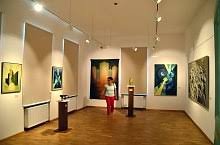
 Interior exhibition hall of the museum · local source
The exhibition presents the life and mathematical genius of János Bolyai not in chronological order but along thematic milestones. The basement's low-stimulus, dim space prepares the visitor for a modern reception of absolute geometry — for attention, focus and wonder.
The exhibition's partners: the Teleki–Bolyai Library in Târgu Mureș, the Transylvanian National History Museum (Cluj-Napoca), the Hungarian National Museum (Budapest), the Hungarian Academy of Sciences and the Institute of Military History.
In November 1823, János Bolyai wrote to his scholarly father, Farkas Bolyai: "out of nothing I have created a new, different world" — meaning he had solved the foundations of non-Euclidean geometry. In 2023, UNESCO proclaimed a Bolyai memorial year in his honour.
What can you see at the museum?
Bolyai – Genius of Transylvania
Interactive exhibition in the basement, with up-to-date museological and audiovisual solutions — enjoyable for the younger generation too, in the spirit of learning through play.
Ethnographic collection
Haáz Rezső's founding collection of over 4,000 items — Székely folk costumes, household tools and folk-art objects from across the Udvarhely Seat.
Local history
The history of Odorheiu Secuiesc and the Udvarhely Seat from the Middle Ages to the present day — reflected in documents, photographs, everyday objects and maps.
Fine arts
Temporary art exhibitions — the Benczúr Gyula memorial exhibition and works by other Transylvanian and Hungarian artists.
Bányai János memorial exhibition
Bányai János (1886–1974), the renowned geologist, researcher of aragonite and mineral waters — the legacy of his more than 100 scientific works.
Székely Gate Museum at Băile Seiche
The open-air section of the museum at Băile Seiche — beside Orbán Balázs's grave, an outdoor collection of carved Székely gates.
200+ years in the service of collecting
First protocol
The first inventory of the Reformed College founded by Count Bethlen János — already then it contained antiquities, a numismatic and geological collection, a natural-history cabinet and an art collection.
Haáz Rezső's collection opens to the public
The 4,000-item folk-art collection founded by drawing teacher Haáz Rezső (1883–1958) became open to visitors. Earlier museum initiatives had failed — this became the viable nucleus.
Becomes a state museum
After the Communist takeover, the museum was turned into a state institution — the continuity of the collection and operations was preserved.
Reunited with the library
The museum was reunited with the town's scientific library, so today it operates as a culturally and scientifically significant centre on a national scale.
Opening of the Bolyai exhibition
Opening of the Bolyai – Genius of Transylvania exhibition, realised with 23 million forints of Hungarian grant funding — a new era of modern museology begins.
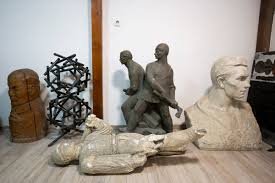
The museum in pictures
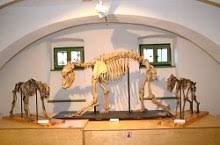
Photo sources: local sources
Useful information
Opening hours (summer: Apr–Aug)
- Tuesday – Friday: 9:00 – 18:00
- Saturday – Sunday: 10:00 – 18:00
- Monday and public holidays: CLOSED
- Winter hours: 9:00–17:00, Sat-Sun: 10–14
Ticket prices
- Adult: 10 RON
- Pensioners, university students: 5 RON
- Pupils (up to 12th grade): 4 RON
- Free: children under 6, persons with disabilities, journalists
- Photo ticket: 10 RON · Guided tour: 15 RON
How to find
- Address: Bethlen Gábor Street 2-6
- Phone: +40 266 218 375
- Web: hrmuzeum.ro
- GPS: 46.3126° N, 25.3050° E
- 10-15 minute walk from the Horseshoe Square
Tips
- The Bolyai exhibition is a must! Better with a guide
- Buy a copy of the History of Székely Land monograph
- Székely Gate Museum at Băile Seiche — a separate trip
- Night of Museums — the Saturday of Midsummer's Eve
Who was Haáz Rezső?
Drawing teacher Haáz Rezső (1883–1958) was one of Odorheiu Secuiesc's most devoted ethnographic collectors. For decades he walked the villages of the Udvarhely Seat — assembling a folk-art collection of more than 4,000 items: folk costumes, household objects, carved furniture, wood carvings and ceramics. Through his work he saved for posterity the vanishing material culture of Székely Land.
Earlier museum initiatives had failed in Odorheiu Secuiesc — only Haáz Rezső's collection succeeded in becoming a stand-alone institution. In 1913 he opened the collection to the public, forming the foundation of today's Haáz Rezső Museum.