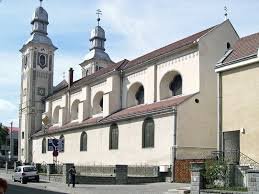
Franciscan Church and Monastery
The oldest and one of the most defining architectural ensembles on the main square of Odorheiu Secuiesc.
A Baroque church built from 1730 — still an active religious, community and educational centre.
The "Friars' Church" — the jewel of the town's main square
The Franciscan Church and Monastery of Odorheiu Secuiesc (popularly: the Friars' Church) is the oldest and one of the most defining architectural ensembles on the town's main square. The Baroque church, built between 1713 and 1779, remains an active religious and community centre to this day.
The two-towered Baroque church — 36 metres long, 17 metres wide, with an interior height of 14 metres — stands on the corner of the main square, at the beginning of Castle Street. Two distinctive towers rise on the main façade, shaping the cityscape even from afar. Next to the church stands the two-storey building of the former Franciscan monastery.
The building bears the marks of the transitional period between Baroque and Classicism and belongs to the Franciscan houses with the strongest traditions in Transylvania — in the 18th century, one of the most populous Franciscan monasteries in Transylvania operated here.
 The two-towered façade seen from the main square · local source
300 years in the heart of the town
The donation of István Lakatos
István Lakatos, parish priest of Cozmeni and a native of Odorhei, donated his paternal inheritance to the Franciscans. The donation included the plot beside the busiest road leading out of the main square, together with the stone house standing on it, which had been converted into a chapel.
Settlement of the Franciscans
The permanent settlement of the Bosnian Observant (Salvatorian) Franciscan friars in Odorheiu Secuiesc. A 245-year unbroken presence in the town began.
Laying of the foundation stone
The foundation stone of the church standing on the southern corner of the plot was laid in 1730. Although the date 1728 also appears on a stone block above the gate, actual construction began only in 1730.
Coming into use
Four years after the foundation stone was laid, the church was already in use for its intended purpose — although the interior furnishings were not yet complete.
Completion of the pulpit
The Baroque carved pulpit was installed in 1747 — one of the earliest interior artworks of the church.
Conventual rank
The Odorheiu Secuiesc monastery received conventual rank — within the Franciscan system, a house of special importance, where several chapter meetings were also held.
The works of Mátyás Veres and Krisztina Perger
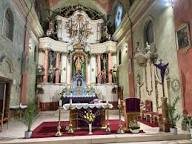
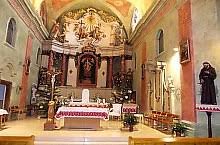
The high altar and the interior walls were painted and gilded by the painter Mátyás Veres and his wife, Krisztina Perger, between 1780 and 1781. The capitals of the altar feature the figures of King Saint Stephen and King Saint Ladislaus, as well as Saint Peter and Saint Paul — remarkably, a female artist also took part in the work.
143 years of primary school
The monastery ran a primary school — for nearly a century and a half it was one of the town's most important educational institutions, especially in the upbringing of Catholic boys.
The ceiling painting by Ferenc Herczeg
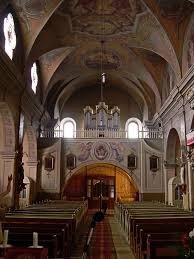
The interior ceiling decoration of the church was created in its still visible form by Ferenc Herczeg, a painter from Târgu Mureș and a pupil of Károly Lotz. His work gave the church its present rich interior appearance.
Deportation of the friars
On the night of 20 August 1951, the communist regime deported the Franciscans and banned the order's activity. The building was first used as a warehouse and later as a boys' boarding house.
Arrival of the Mallersdorf Sisters
Part of the monastery was given to the Franciscan Sisters of Mallersdorf for 25 years. The nuns still live and serve in the building today.
Return of the Franciscans
The friars were able to return to Odorheiu Secuiesc in 2000, after 49 years. Continuity was restored — the Seraficum Franciscan College is still in operation.
The interior treasures of the church
High altar
1780–1781: painted and gilded by Mátyás Veres and Krisztina Perger. Its central figure is the life-size statue of the Virgin Mary, flanked by Saint Stephen, Saint Ladislaus, Saint Peter and Saint Paul.
Pulpit
A Baroque carved pulpit made in 1747 — one of the church's oldest interior artworks, with richly carved figurative decoration.
200-year-old organ
The church's pride: a nearly 200-year-old Baroque organ still in working order. Its sound still fills the nave — a perfect vehicle for Baroque sacred music.
The Herczeg ceiling
1928: Ferenc Herczeg, Károly Lotz's pupil from Târgu Mureș, painted the ceiling of the nave. The decoration is still visible in its original form.
Painted stained-glass windows
A painted stained-glass window dated 1901, bearing a Hungarian-language inscription — a valuable example of early 20th-century religious art.
Two bells and 7 altars
In the eastern tower two bells ring out. The church space contains seven altars — the high altar and six side altars dedicated to the veneration of Mary, Christ and the saints.
The church in pictures
Képek forrásai: local sourceok
A living church — a living community
The Franciscan church and monastery are not merely a heritage monument — they are a living religious and educational centre. The monastery building today houses the Seraficum Franciscan College, dedicated to Saint Anthony, which provides boarding and religious-moral education for 19 secondary-school boys. House superior: Fr. Kádár Ernő Kristóf OFM.
The church is a popular venue for the Saint Anthony Great Novenas and for spiritual retreats — for Catholic faithful, one of the main spiritual centres of Odorheiu Secuiesc. The perpetual eucharistic adoration day is 4 October (the feast of Saint Francis).
Useful information
How to find
- Address: 2 Tamási Áron Street
- Town: 535600 Odorheiu Secuiesc
- Phone: +40 266 213 016
- GPS: 46.3045° N, 25.2939° E
Opening hours
- The vestibule is open 24/7
- Holy Mass: Sundays and feast days: 9:00 and 18:00
- Weekdays: 19:15
- Interior viewing during services
What to see
- The high altar by Mátyás Veres and Krisztina Perger
- The 1747 Baroque pulpit
- The 200-year-old organ
- Ferenc Herczeg's 1928 ceiling
- The 1901 stained-glass window
Tips
- FREE admission
- Quiet meditation: in the early morning hours
- 4 October — perpetual eucharistic adoration
- Next to Horseshoe Square, pedestrian zone