The Franciscan Pilgrimage Church and Monastery of Șumuleu Ciuc
Universal spiritual stronghold of the Hungarian people and Marian shrine — centuries of Franciscan tradition and the heart of the Pentecost pilgrimage
The Pilgrimage Church of the Visitation of the Blessed Virgin Mary and the Franciscan Monastery of Șumuleu Ciuc is one of the most important religious, intellectual and historical centres of Hungarians across the Carpathian Basin and around the world. Although Șumuleu has been administratively part of Miercurea Ciuc since 1959, its unique sacred aura keeps it alive in the public consciousness as a distinct concept of its own.
The heart of the shrine is the monumental, 19th-century Baroque basilica, whose main altar is crowned by the largest miraculous Virgin Mary statue in the world. The centuries-long presence and spiritual work of the Franciscan friars made Șumuleu Ciuc the foremost bastion of national identity and the centre of the Pentecost votive pilgrimage.
The construction history of the shrine
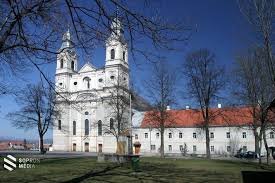
The Gothic foundations and John Hunyadi's donation
The Franciscan friars built the first Gothic church and monastery between 1442 and 1448, partly funded by a donation from John Hunyadi (Hunyadi János) — drawn from the spoils of his victory over the Ottomans. The church was consecrated in honour of the Visitation of the Blessed Virgin Mary (Sarlós Boldogasszony); this remains the church's own feast day, held on 2 July.
Of the original Gothic monastery only a portal and a single cellar window survive today — the rest fell to the Tatar raid of the 17th century and subsequent rebuildings. The church and monastery were enclosed by strong stone walls, behind which the local people could shelter when enemies invaded.
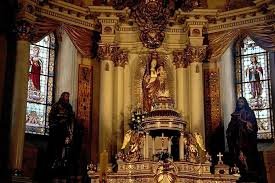
Building today's Baroque pilgrimage church
By the end of the 18th century, the Gothic church had become too small for the growing flow of pilgrims, so in 1802 the Franciscans decided to build an entirely new, monumental church. Construction of the new Baroque church began in 1804 from plans by the architect Konstantin Schmidt — its two imposing bell towers were completed in 1830.
The church was consecrated on 20 August 1876 by Mihály Fogarasy, Bishop of Transylvania. The Virgin Mary statue on the façade was made in 1837 by the Brașov coppersmith Rothenbacher. The interior — largely the work of the Brașov painter and sculptor Miklós Papp — is enriched with abundant gilding, monumental chandeliers and finely crafted pews. In 1948, Pope Pius XII raised the church to the rank of basilica minor.
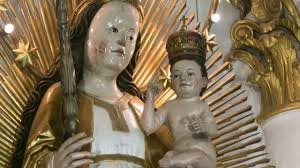
Babba Maria — the world's largest miraculous statue
The most precious treasure of the main altar is the Renaissance Virgin Mary statue, carved from lime wood and gilded at the beginning of the 16th century (1510–1520). At 2.27 metres tall, it is the largest known miraculous Virgin Mary statue in the world — one that miraculously survived the Turco-Tatar arson of 1661.
The Virgin Mother is portrayed, in the words of the Book of Revelation, as the „woman clothed with the sun": girt with a halo of rays, she stands on the crescent moon, crowned, holding a sceptre in her right hand and the Infant Jesus in her left. The aureole of 12 stars alludes to the Apocalypse vision. The Csángós of Moldavia call her tenderly Babba Maria.
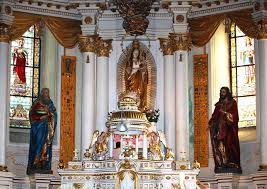
The papal Golden Rose award
The most significant modern milestone of the shrine was Pope Francis's visit on 1 June 2019. On that occasion, the Holy Father presented the Virgin of Șumuleu Ciuc with the Golden Rose (Rosa d'Oro) — a richly detailed floral composition wrought in precious metal.
This award is the highest distinction of the Holy See, reserved for the world's foremost Marian shrines. The Golden Rose can still be seen in the basilica today, placed right next to the miraculous statue — a fitting confirmation of the centuries-old veneration that surrounds the Babba Maria of Șumuleu Ciuc.
The monastery's spiritual legacy — milestones
First documented mention
The first known written mention of the Șumuleu church — the settlement already appears in 1335 under the name Sumlov.
Pope Eugene IV's indulgence charter
The pope granted an indulgence by encyclical letter to all who supported the building of the church.
The battle of Tolvajos Pass
On Pentecost Saturday the Catholic Székelys repelled John Sigismund's army — the birth of the votive pilgrimage.
The Great Tatar Raid
The forces of Ali Pasha of Timișoara burned down the church and monastery — yet the Virgin Mary statue was saved as if by miracle.
Founding of the Kájoni Press
Father Joannes Kájoni founded the only Catholic printing house in Transylvania, which remained the sole press in the region until 1727.
Cantionale Catholicum
The first publication of the press: Kájoni's Latin–Hungarian hymnbook, still in use today.
The present basilica begins
Construction of the Baroque church starts after Konstantin Schmidt's plans — it will be consecrated in 1876.
Basilica Minor rank
Pope Pius XII raised the church to the rank of papal minor basilica, recognising its universal spiritual significance.
Rediscovery of the Kájoni Codex
The 17th-century musical manuscript, lost since 1944, is found hidden inside the wall of the monastery's refectory.
Pope Francis's visit
The Holy Father presents the Golden Rose to the Virgin Mary — the highest papal recognition for the shrine.
Hungarikum status
The Pentecost pilgrimage of Șumuleu Ciuc and the shrine itself are officially inscribed in the Hungarikum register.
Treasures of the church and monastery
The Wegenstein Organ
1931 · TimișoaraBuilt by the „Leopold Wegenstein and Sons" organ factory of Timișoara, this instrument is one of the finest organs in Transylvania — with 2,824 pipes and 40 solo stops. It was made to the designs of József Geyer and stands on the site of the 17th-century Kájoni organ.
The Kájoni Codex and the manuscripts
17th centuryThe single most important document of 17th-century Transylvanian music history — 346 musical pieces in organ tablature notation. The codex, long thought lost, was discovered in 1985 inside the monastery wall. In 1980, a further four Kájoni manuscripts were found beneath the Virgin Mary statue: the Calendarium, Herbarium, Hymnarium and the Black Book (Liber niger). Today they are kept at the Székely Museum of Ciuc.
The Franciscan library
16th — 18th centuryOne of the most precious medieval ecclesiastical collections in Transylvania — featuring incunabula, illuminated codices and rare books. A refuge for the Transylvanian Catholic book heritage during the Protestant principate. A significant portion is preserved at the Székely Museum of Ciuc.
Outstanding ecclesiastical and national values
Hungarikum status
The Pentecost pilgrimage of Șumuleu Ciuc and the shrine were officially inscribed in 2020 into the Hungarikum register.
Sarlós Boldogasszony feast
The church's own patronal feast falls on 2 July — the day on which the original Gothic church was consecrated to the Visitation of the Blessed Virgin Mary.
The Franciscan grammar school
The famous Franciscan grammar school of Șumuleu Ciuc operated alongside the monastery from 1667 onwards — Sándor Petőfi himself passed through it — and was the alma mater of many notable figures until 1911.
„Șumuleu Ciuc is not just one shrine among many, but the eternal symbol of the survival of the Hungarian people, of their spiritual unity and of the uncompromising defence of their Christian faith."
Visitor information
Address and location
148 Szék Street, Șumuleu (Miercurea Ciuc), Harghita County.
From the city centre it is easily reached on foot or by public transport, following Szék Street — about 3 km north-east.
Key events
Pentecost Saturday: the starting and ending point of the Șumuleu Ciuc pilgrimage.
2 July: the church's own patronal feast, the Visitation of the Blessed Virgin Mary (Sarlós Boldogasszony).
Friday-evening vigils and daily Masses throughout the year.
Related sights
After visiting the pilgrimage church, it is well worth walking up along the Stations of the Cross into the Șumuleu Saddle between Little and Great Șumuleu Hill, to the Triple Hill Altar and the Salvator Chapel.
Discover more sights of Miercurea Ciuc and its surroundings!
Get to know the open-air setting of the Pentecost pilgrimages, the Șumuleu Saddle, or visit the historic Mikó Castle in the city centre!