Pentecost Pilgrimage at Șumuleu Ciuc
The most significant Christian event and spiritual stronghold of all Hungarians
Every year at Pentecost, in the saddle between Little and Great Șumuleu Hill
The centuries-old vow of the Székelys
The origins of the Șumuleu Ciuc pilgrimage reach back to the 15th century, when Franciscan friars settled in the area. In 1444, Pope Eugene IV granted an indulgence by encyclical letter to all who supported the construction of the church.
The tradition of the votive pilgrimage on Pentecost Saturday is, according to popular memory, rooted in the Victoria de la Șumuleu (1567) — the battle of Tolvajos Pass. John Sigismund, Prince of Transylvania, sought to convert by force of arms the Catholic populations of Ciuc, Giurgeu and Cașin to Unitarianism. On Pentecost Saturday, the Székelys, defending their faith, defeated the prince's army while their women and children prayed in the church of Șumuleu. The pilgrimage has been held ever since each Pentecost, in remembrance and gratitude for that victory.
Since the Treaty of Trianon, the Șumuleu Ciuc pilgrimage has long outgrown its confessional setting: today it is the foremost symbol of the national and spiritual unity of Hungarians worldwide.
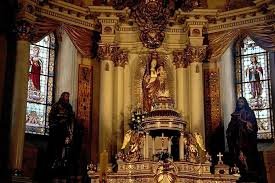 The Baroque main altar of the Franciscan Pilgrimage Church of Șumuleu Ciuc, with the miraculous Virgin Mary statue
Babba Maria — the woman clothed with the sun
The Virgin Mary statue that crowns the main altar of the Pilgrimage Church is the largest known miraculous statue in the world. A Renaissance masterpiece carved from lime wood and gilded in the early 16th century (1510–1515), it miraculously survived the Tatar arson of 1661.
Sun and Moon symbolism
The Virgin Mother stands on the globe and on a human-faced crescent moon; above her head shines a halo of twelve stars — the woman clothed with the sun from the Book of Revelation.
Pilgrimage tokens and touching the statue
For centuries, pilgrims have followed the custom of touching their consecrated objects and birch boughs to the foot of the statue, in order to carry the Virgin Mother's blessing back home.
Dawn sun-gazing
A mystical tradition of the Csángó pilgrims: at dawn on Pentecost Sunday, they wait on Little Șumuleu Hill for the sunrise, in whose rays they believe the Holy Spirit may be glimpsed.
The historical arc of the pilgrimage
How a local Székely votive feast became a national event that stirs the whole Carpathian Basin:
The „silent pilgrimage" of 1949: the communist authorities banned the pilgrim trains, yet Bishop Áron Márton arrived on a white horse before the crowd of hundreds of thousands, bearing witness to an uncompromising Christian faith.
Key elements of the pilgrimage
The Labarum
The 36 kg processional emblem of victory, traditionally carried by the most distinguished graduating students of the Mary Help of Christians School.
The parish processions (keresztaljak)
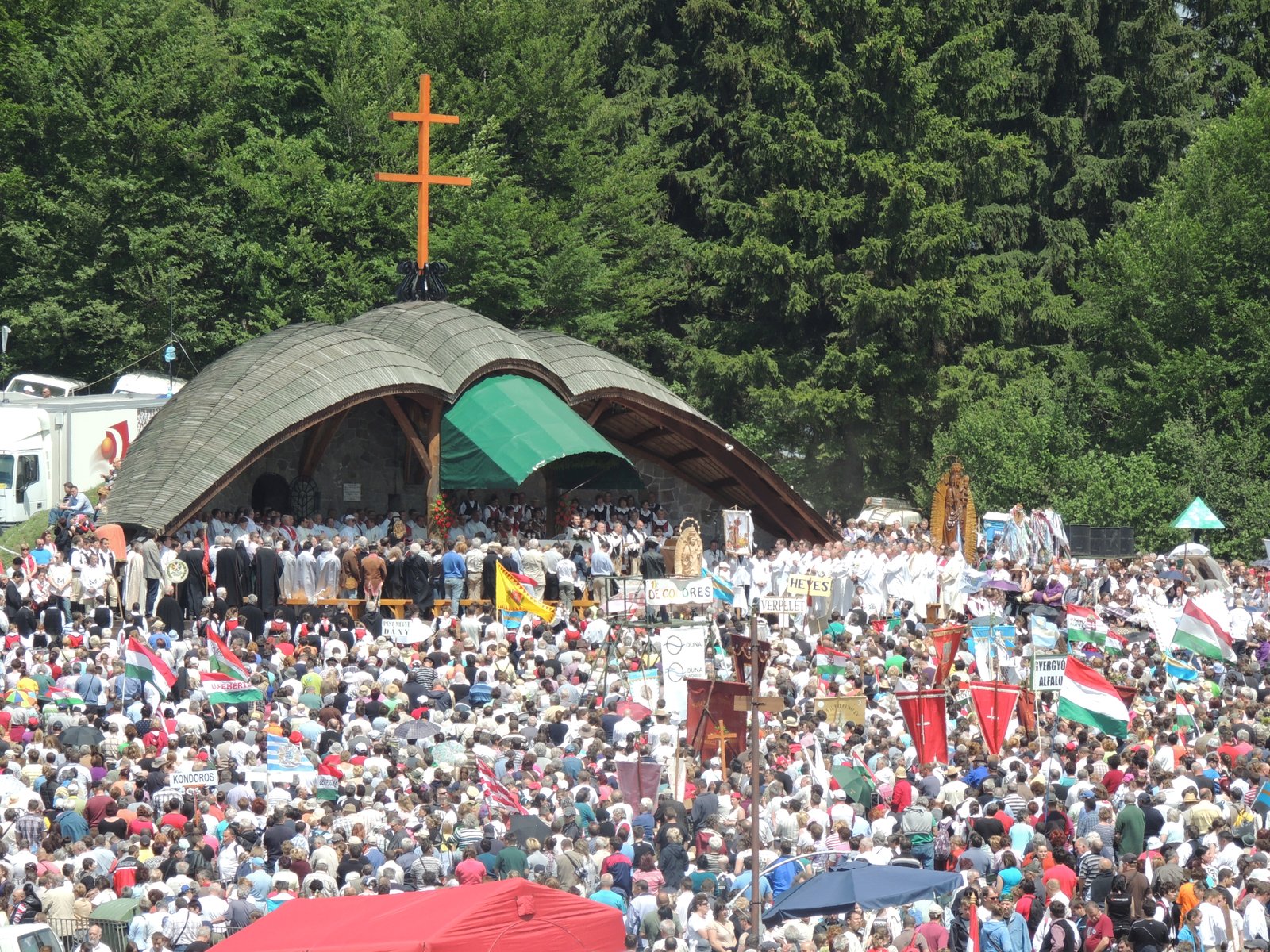
Groups of the faithful marching beneath church banners and behind the cross. The procession is always led by the group from Joseni (Gyergyóalfalu).
The Triple Hill Altar
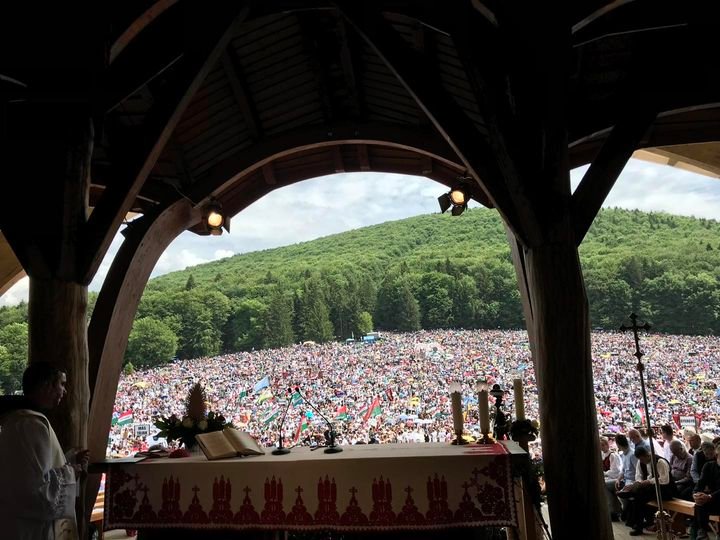
The open-air altar designed in the spirit of Imre Makovecz — the permanent setting of the Pentecost High Mass attended by hundreds of thousands.
Practical information and customs
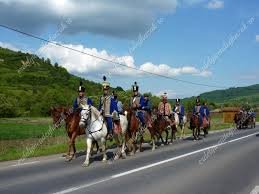 The mounted processions of the Ghimeș Csángós and the Ciuc Székelys, on their way to the Saddle
The legendary atmosphere of the Șumuleu Ciuc pilgrimage is created by the arrival of the parish processions, both on foot and on horseback. The surrounding villages — Joseni, the Ghimeș valley and the Moldavian Csángó communities in particular — make their way to the Saddle in traditional folk dress, with banners and song. The mounted processions revive a centuries-old Székely tradition.
The liturgy follows the Romanian time zone (one hour ahead of Hungary). The solemn Friday-evening vigil begins in the Pilgrimage Church, and the Saturday High Mass starts at 12:30 at the Triple Hill Altar.
Processions on foot
- Pilgrims arrive bearing the banners of their own parishes, singing and praying.
- The Ghimeș and Moldavian Csángós march in pristine white traditional folk costume.
Traffic restrictions
- A strict vehicle ban is in force across Șumuleu on Pentecost Saturday.
- The Saddle can be reached only on foot, along the designated routes.
Pilgrim trains
- Special trains depart from Budapest every year (Csíksomlyó Express, Székely Gyors).
- The trains are received with great solemnity at stations across Székely Land.
Important reminder
- The liturgy follows the Romanian time zone (one hour ahead of Hungary).
- The solemn vigil begins in the Pilgrimage Church on Friday evening.
Things to know about the pilgrimage
The Mass said for the Moldavian Csángós — the so-called Csángó Mass — is the only occasion in the year when they may hear the Sacred Liturgy in their own mother tongue at Șumuleu Ciuc.
Each year, the pilgrimage is built around a unique spiritual motto, chosen specifically for that edition.
During his visit in 2019, Pope Francis presented the miraculous statue with a Golden Rose — the highest recognition that the papacy grants to major Marian shrines.
The pilgrims' favourite traditional souvenir is the hand-decorated Ciuc gingerbread heart with its small mirror inset.
🚑 Red Cross volunteers at the pilgrimage
The Gheorgheni branch of the Harghita County Red Cross takes part every year in the running of the Șumuleu Ciuc pilgrimage, providing all-day medical and emergency care for the duration of the event.
❤️ Continuous standby: the volunteers hold a full-day watch — from the arrival of the dawn processions to the homeward journeys in the afternoon — at the disposal of the several hundred thousand pilgrims. From first aid to the handling of urgent cases, they perform all basic medical duties.
🎓 Professional background: the Gheorgheni branch has trained volunteers who have completed first-aid and emergency-care courses. The unit regularly takes part in the „Skilled medics" competitions, where it has achieved notable results.
🌍 Local community value: the branch is one of the most active Red Cross organisations in the region — present throughout Harghita County and securing many events: the Șumuleu Ciuc pilgrimage, the Giurgeu Equestrian Days, and various local sporting and community events. They also carry out joint search-and-rescue operations with Salvamont mountain rescuers.
 The volunteer team of the Gheorgheni branch of the Harghita County Red Cross on site · own photograph
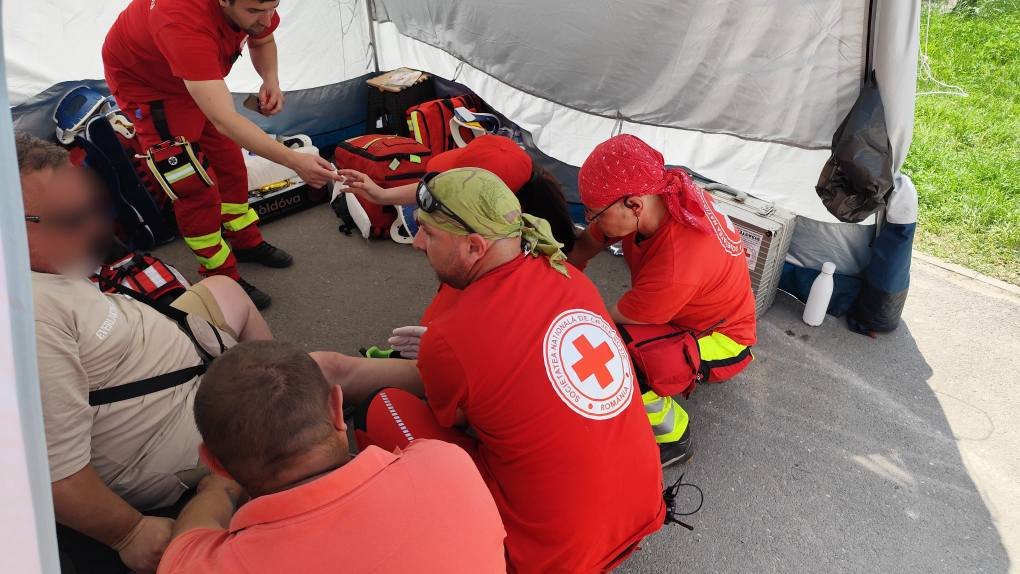 Red Cross volunteers providing first aid during the pilgrimage · own photograph
Discover more treasures of Miercurea Ciuc
After the Șumuleu Ciuc pilgrimage, get to know the city's historic castle, its mineral baths, and the hiking trails of the surrounding Harghita Mountains.
Mikó Castle and the Székely Museum of Ciuc
The best-preserved late-Renaissance castle in Székely Land — the legacy of Ferenc Mikó of Hídvég and the region's richest ethnographic collection.
DetailsBăile Jigodin and the mineral waters
Miercurea Ciuc's own folk spa on the banks of the Olt — mineral springs, mofettes and warm tub baths for those with rheumatic complaints.
DetailsBăile Harghita and hiking trails
The mountain resort at the heart of the Harghita Mountains — the ridge paths leading from the Uz Bence chalet and Madarasi-Hargita Peak.
DetailsBack to the main Miercurea Ciuc page
See the city's full tourist offer in one place — history, gastronomy, culture and nature.
Main page