The Roman Catholic Fortified Church of Cârța
The most imposing sacred bastion of the Upper Ciuc basin — medieval Gothic heritage and a massive defensive wall system with loopholes, under the patronage of the Assumption of the Virgin Mary
The Cârța Roman Catholic fortified church (also known as the Church of the Assumption) is one of the most significant architectural and religious treasures of the Upper Ciuc basin. It stands on the boundary between Cârța (Csíkkarcfalva) and Ineu (Csíkjenőfalva), on a prominent rise visible from afar, and is a true landmark of the region. The monumental fortified complex faithfully reflects the historical role of Székely fortified churches as defenders of both faith and community.
The church, built on Gothic foundations, is enclosed by a massive, high curtain wall of irregular oval form, which for centuries provided a safe refuge to the local population during Ottoman and Tatar raids. Its religious heritage and patronal feasts are closely tied to the deep Marian traditions of the Ciuc region.
Centuries of the fortification
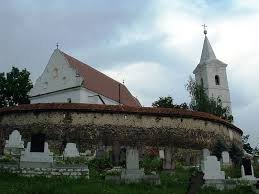
A landmark fortified church in the Upper Ciuc basin
The siting of the Cârța Church of the Assumption follows the classical principles of medieval defence. It was built where Cârța and Ineu meet, on a prominent, easily visible elevation, so that it might serve as a landmark from any corner of the basin while also functioning as a military observation point.
The composition is dominated by the Gothic bell tower rising proudly from the massive curtain wall. At its uppermost level runs a wooden defensive walkway (gyilokjáró) fitted with loopholes, which proclaimed from afar the steadfastness of faith and self-defence.
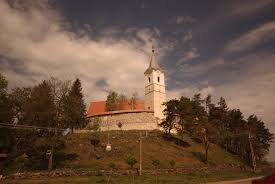
The defensive wall with loopholes and pitch chutes
The most important element of the Székely fortified churches is the curtain wall that shields the nave like a buckler. The Cârța church is surrounded by an unusually thick, irregularly oval curtain wall, raised at the end of the 16th century as a direct defence against the Ottoman–Tatar raids.
On the walls one can clearly see the narrow loopholes flaring inwards, and the pitch-pouring openings through which the armed inhabitants of the surrounding villages successfully repelled the invading mounted troops, protecting the families taking shelter within.
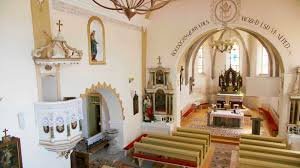
Medieval net vault and Baroque splendour
The interior of the church faithfully preserves the architectural craftsmanship of the Gothic era. The inner covering of the chancel is formed by a fine, artistically worked Gothic ribbed cross-vault, among the most beautiful and best-preserved vaults in all of Transylvania.
The later, 1796 remodelling of the nave already bears Baroque stylistic features. The religious and aesthetic centre of the interior is the monumental, gilded Baroque high altar and the richly carved pulpit, which together exude a majestic atmosphere.
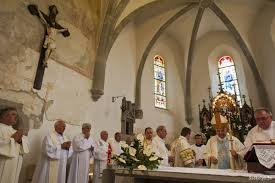
The Gothic chancel wall and the inner arc of the fortified courtyard
Walking inside the fortified enclosure, the most valuable exterior part of this 15th-century building reveals itself: the polygonal closure of the Gothic chancel. The weight of the massive stone walls is taken up, according to the rules of classical medieval architecture, by monumental external buttresses that channel it down to the ground.
The grassy castle courtyard, framed by the exterior wall of the chancel and the inner arc of the curtain wall, once served as a safe refuge where the believers of the Upper Ciuc basin could store their baskets during sieges, while the stone walls and the massive structure of the chancel protected them like a physical shield.
Summary photo gallery
The photographs faithfully reflect the architectural duality of the fortified church: the stern external defences and the breathtaking interior sacred beauty.
Notable historical values
A communal bastion of refuge
The fortified church was built and defended not by a single lord but by the joint effort of three neighbouring villages — Cârța, Ineu and Dănești.
Cult of the Assumption of Mary
The patronal feast of the church is the Assumption of the Virgin Mary, a devotion deeply rooted in the Marian tradition of the Ciuc region.
Original wooden walkway
The wooden loop-holed defensive walkway at the uppermost level of the bell tower is one of the most beautiful and best-preserved pieces of medieval carpentry in the county.
"The fortified churches of Ciuc speak not only of the strength of stone and lime, but also of the unbreakable faith and yearning for freedom of the Székely people, which in even the most perilous times found shelter here."
Visitor information
Location
Close to the centre of Cârța, on a hill rising along the main road.
Harghita County, Upper Ciuc, Transylvania.
Access
The castle courtyard and the external surroundings of the church can be visited freely. To view the Gothic interior, it is best to enquire at the local parish or with the bell-ringer.
Getting there
To the north of Miercurea Ciuc, on the DN12 national road, at about 22 km (~25 min. by car). Coming from Gheorgheni towards the south, it is equally easy to reach by car or by train.
Discover the other treasures of the surroundings!
After the Cârța fortified church, visit the nearby Mădăraș Peak, the pilgrimage site of Șumuleu Ciuc or the other remarkable mineral springs of the Upper Ciuc basin.