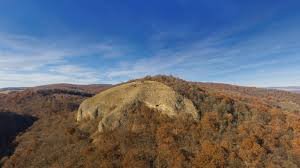
Budvár Hill
The site of Odorheiu Secuiesc's oldest fortress — where, according to legend, the Székelys
made their alliance with Chieftain Árpád, and where Neolithic man already lived.
The ancient rock crest rising above the town
The Budvár Hill is a 625–635-metre rocky height rising at the western exit of Odorheiu Secuiesc, on the right bank of the Târnava Mare. Its geological interest lies in being a conglomerate rock crest — a unique natural formation in the area.
This site is home to the town's earliest fortress, Budvár, today visible only as ruins and earthworks. The hill is at once an archaeological site and a nature reserve — protected for its geological and botanical value.
The ruins have been listed in Harghita County's register of historic monuments since 1992 as an official monument. The hill lies at the exit towards Cristuru Secuiesc, opposite the Jesus Chapel.
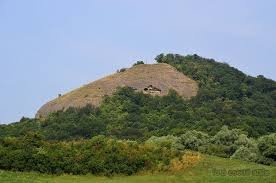 The conglomerate rocks of Budvár Hill · local source
Chieftain Buda, Zandirhám and the alliance with Árpád
According to legend, the castle was built by Chieftain Buda — brother of the Hun king Attila — even before the fall of Attila's empire. Folk tradition holds that the hero Zandirhám resided here, the supreme rabonban of the Székelys — those who broke away from the Huns and withdrew into the mountains — at once chief judge, high priest and warlord of the nation.
The most thrilling point of the legend: when the Hungarians arrived under Árpád, Zandirhám welcomed the kindred people through his envoys, and, taking part in the conquest of Pannonia, entered into an alliance with Árpád. The law engraved on 6 stone tablets, received from Árpád, was read out before the nation at Budvár during a sacrificial ceremony, then sealed with a blood sacrifice — and "placed in the court of the rabonban, after which a great feast followed".
The source of the legend is the Székely Chronicle, published by Mihály Székely — though historians rightly question the chronicle's authenticity. Even so, Budvár has remained the heart of Székely mythology and identity through the centuries.
Thousands of years of human presence
Alongside the legend, archaeology paints an extremely exciting picture of Budvár: Stone Age people already lived here, and the area has been continuously settled for millennia.
People of the Polished Stone Age
Stone Age (Neolithic) people had already settled on Budvár — stone tools and pottery fragments attest to this ancient human presence. The height offered an ideal defensive position.
Early and Late Iron Age settlement
People of the Early and Late Iron Age also lived here. Iron tools, weapons and other items were uncovered — forming a continuous cultural layer.
Roman fortification
According to archaeological evidence, an earlier Roman fortification stood here — serving as the foundation for the later Árpád-era castle. The Romans had already recognized the strategic importance of the height.
The Árpád-era castle
The actual castle was built in the 11th–12th century as a watchpost fortress, reusing the remains of the Roman fortification. From here, signal fires were used to alert the neighbouring castles in case of danger — it was part of a communication network.
Earth huts and wall remains
Archaeologists uncovered earth huts and the wall remains of a fortification — clear proof of the Árpád-era settlement.
Destruction by the Tatar invasion
Budvár was likely destroyed during the Tatar invasion of 1241, when the Tatars overran the region and demolished the castle. According to tradition, however, the hill's cavities continued to offer refuge to the Székelys for a long time afterwards.
Official historic monument
In the official register of historic monuments of Harghita County, the ruins of Budvár are listed as an architectural monument. Protection extends to both archaeological and nature-conservation values.
The Csicser legend — Budvár's love story
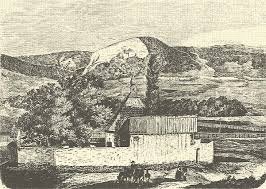 View from Budvár Hill of the opposite Csicser Hill · local source
The opposite Csicser Hill was the outer fort or watchtower of Budvár — and legend connects the two heights with a romantic love thread.
According to the tale, in the castle on Csicser Hill lived Csicser — a famed knight, who fell in love with the fairy-beautiful daughter of the rabonban of Budvár. The father, however, looked down on the poor knight as unworthy of princely blood. The sorrowful young man sat yearning in his small castle, his gaze forever fixed on the bastions of Budvár.
The fairy-beautiful maiden often appeared atop the bastion and sent her love letters flying on arrows — declaring she loved him despite her father's ban and would love him forever. In a battle, when the young man saved the rabonban's life, he asked for the maiden's hand as reward — and received it. The two lovers were finally reunited between the two hills.
💡 Tip: It is worth combining a visit to Budvár Hill with the opposite Csicser Hill — also an important historic site and a popular hiking destination.
What can you see on top of the hill today?
Castle ruins and earthworks
The earthworks and wall remains of the former castle are still visible today. The summit plateau has a perimeter of 650 paces, with its western and southern sides dropping off as steep walls.
360° panorama
From the top, a magnificent view opens onto Odorheiu Secuiesc and the surrounding mountains. On clear days, the northern spurs of the Harghita Mountains can also be seen.
Protected flora
The hill is protected for its geological and botanical value — special rock-dwelling plant species and fungi live here. Information boards present the local wildlife.
Information boards
Along the route, several information boards draw attention to the area's trees, wildlife, fungi, geological rarities and flowers.
Conglomerate rocks
The hill holds special geological value: conglomerate rock — a compressed amalgam of many rock and mineral types. A rare phenomenon at the foot of the Harghita range.
Mountain hollows
The hill's hollows offered refuge for centuries to the local Székelys, even after the Tatar invasion — it is worth walking around the rock formations.
Budvár in pictures
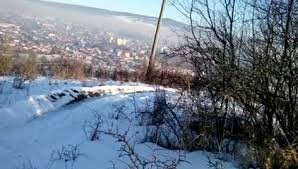
Photo sources: local sources
How can you get up there?
Budvár Hill gyalogosan mintegy fél óra alatt elérhető a városközpontból. Kiindulópont: a Székelykeresztúr felé vezető kijáratnál, a Jézus-kápolnával szemben.
The route follows a pedestrian hiking trail — easy difficulty, suitable for families too. Along the way, information boards present the area's trees, wildlife, fungi, geological rarities and flowers.
💡 Tip: The full outing (round trip + looking around at the top) takes about 1.5–2 hours. Take water with you and, if possible, good hiking boots for the rocky sections.
Useful information
How to find
- Location: western exit of Odorheiu Secuiesc
- River: right bank of the Târnava Mare
- Start: opposite the Jesus Chapel
- Altitude: 635 m above sea level
Time needed
- One way: about 30 minutes on foot
- Full hike: 1.5–2 hours
- Level: easy, family-friendly
- Rocky sections: take care!
When
- Open year-round
- Best: spring–autumn
- Admission: FREE
- Winter hike: only with proper gear
Tips
- Hiking boots recommended on the rocky sections
- Bring water with you!
- Read the information boards
- Combine with Csicser Hill